
Last Updated: January 28, 2020
The record cleaning mix muddle
Tired of paying £20 for a litre for record cleaning fluid for your Moth, VPI or other vacuum machine and waiting weeks for the postman to call each time you run out? In a recent conversation with the manufacturer of one record cleaning machine, a Director confided “I don’t know why people just don’t make their own, it’s very simple, but as long as they want to pay me for it, I’ll make it”. My recipe works out a third of the cost and is based on a commercial formula.
It is intended for use with a record cleaning machine which vacuums off the fluid. I don’t recommend the fluid simply for “washing” and drying through evaporation because that simply leaves dissolved contaminants in place.
Let Me Google That For You: lots of bad advice freely available
A quick internet search on how to make record cleaner fluid will give you assorted home-made recipes and much poor quality advice – superstition, myth, contradictory claims, and in some cases, dangerous advice, however well-intentioned. I suspect there is something rooted in our childhood to do with cleaning that triggers feelings and emotions . A legacy of potty training, or perhaps a memory of spoiling something by applying too much force, gets projected on to the process. Just relax, it will be all right!
Here are some examples of bad advice found on the Internet:
Recipe for confusion
- “I caution against home brew concoctions. Store bought ingredients simply can’t match the purity of commercial formulations.”
- “I took the LP to the sink, gave it a good dousing of Windex and wiped ‘er down with a fresh J-Cloth…. The result was astounding. The record sounded mint!”
- “400ml water, 2 drops of household washing up liquid and a cap of malt vinegar”
- “Squirt lighter fluid on a clean, soft cloth and gently wipe the record surface. The lighter fluid will evaporate, so the record doesn’t need to be rinsed.”
Water source confusion
- “I’ve used the melted ice from my freezer (filtered), as my physics lecturer and
audiophile friend says this is as good as any other.” - “We’re talking about ‘safe for human consumption’ tap water here, isn’t this preoccupation with absolutely pure water a little anally retentive?”
Alcohol dilution rate confusion
- “I use roughly 1 part Isopropyl to two parts purified water …..”
- “90% Isopropyl Alcohol, 5% – Anti-Microbial soap 5% – de-ionized water”
- “Those of you that use Isopropyl you must be careful: Isoproply will harden vinyl.”
Wetting agent confusion
- “A few drops of photographic wetting agent. … just a drop of washing up liquid as a wetting agent ….. 10 drops Photo-Flo + 10 drops “Direct” tile cleaner ….. a teaspoon of car washer fluid ….. 7-8 drops dishwashing detergent without additives ….. 1 drop Triton X-114 or Monolan 2000 ….. 10 drops of Kodak Photo-Flo and 10 drops of Lysol Antibacterial All-Purpose Cleaner….Dawn Dishwashing Fluid,…. few drops of dish washing soap without lubricants. …..3-4 drops per gallon Kodak Photoflo …..a few drops of Ilfotrol (sic) photographic wetting agent.”
NOW FOR SOME GOOD ADVICE: –
THE LJC FORMULA, TRIED AND TESTED, SAVES TIME, NO WORRIES
INGREDIENTS:
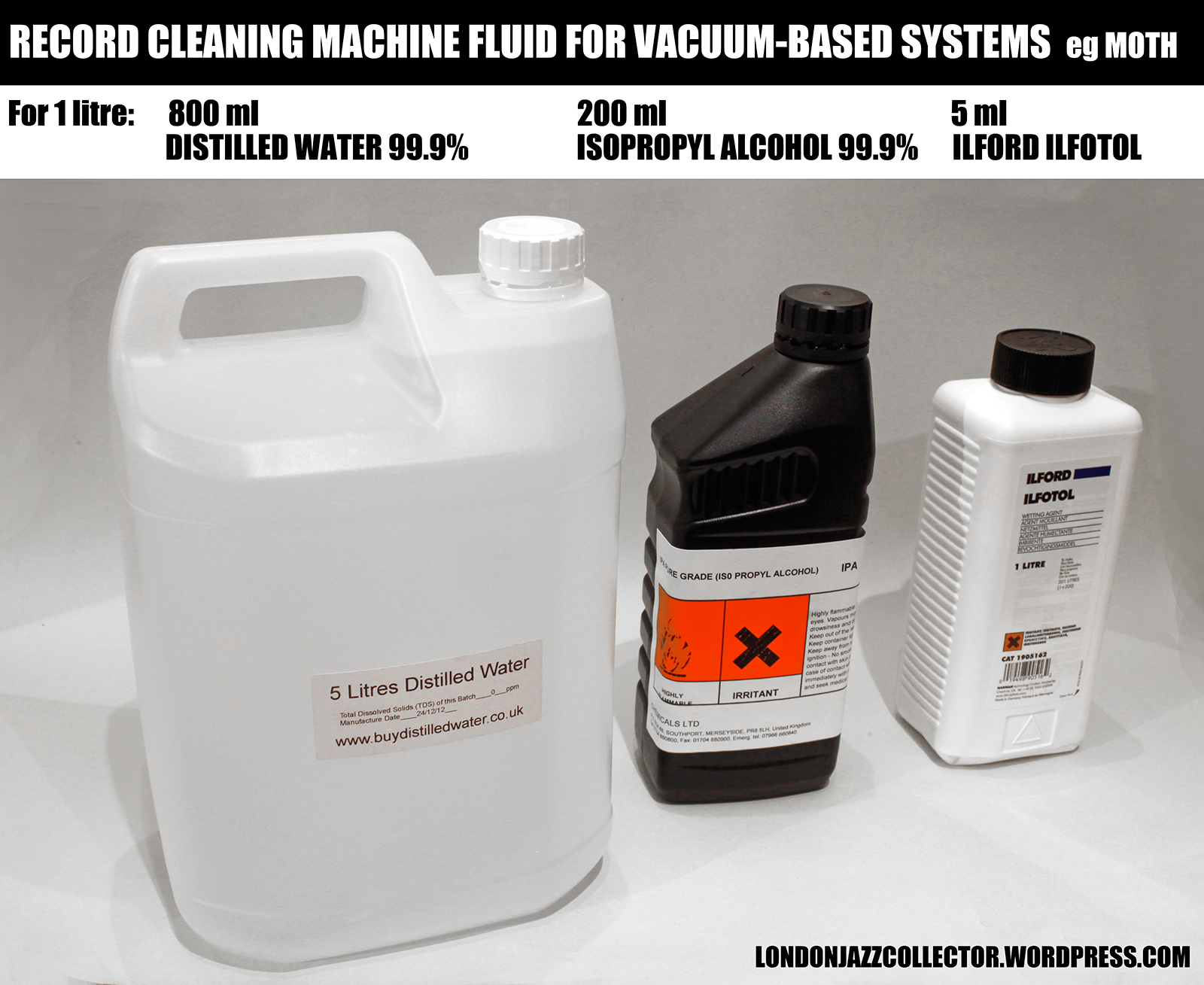

Use only the purest ingredients, purchased online from reputable chemical suppliers, and store final mix in clean glass or plastic bottle suitable for containing alcohol.
Ingredient 1. Isopropyl Alcohol
The purpose of cleaning is to ensure naked contact between the stylus and the information encoded into the grooves, and nothing between the two, hence the use of alcohol to dissolve any surface contaminants (cigarette smoke, skin oils, mould-release, airborne matter) which are then vacuumed away.
The main active cleaning ingredient is the well known and commonly used Isopropanol, known as Isopropyl AlcohoI or lPA for short . It is readily available from chemical suppliers at 99.9% purity – the highest laboratory-grade commercially available. One litre costs about $10, and diluted with pure distilled water, it will make five litres of record cleaning fluid, which should keep you going for a year or two.
Health warning: IPA is a poisonous alcohol, unlike its chemical relative used in some record cleaning recipes – Ethanol , though even that is treated to prevent human consumption – and avoid taxation of alcoholic beverages. High Street pharmacies are not a good source – they seem to treat anyone wanting to buy pure alcohol with suspicion, some refuse to sell it, or price it prohibitively to discourage misuse. UK high street chemists Boots charge three times the commercial price of isopropanol, making it more costly than a good single malt whisky. Lower concentrations of alcohol, like rubbing alcohol (70% IPA), are a false economy when you can but the pure stuff, cheaply and reliably on line, with no added ingredients to make it smell nice or colour co-ordinate with your room decor.
To get a sense of perspective, my recommended dilution rate of 1:4 is just slightly stronger than a glass of wine. How worried would you be about a splash of wine accidentally spilled on a record, and quickly washed off? I mean apart from the wine wasted.
There are commercial alternative cleaning fluids which depend entirely on detergent rather than alcohol, such as L’Art du Son, which have their followers. I have tried that, it is expensive, not as effective, didn’t wet in as quickly as my alcohol formula, a nuisance to constantly make up small batches, and after a few months I found it throws deposits in the bottle and looks like something is growing in it. I’m not a fan of detergent-based cleaners.
Ingredient 2: Distilled Water
The highest purity of distilled water is triple filtered and steam condensed/distilled to eliminate thoroughly the contaminants and mineral deposits in tap water. Avoid water sold for other purposes, such as car batteries, and on no account use tap water. By using pure distilled water with this IPA recipe you will still save two thirds of the cost of commercial record cleaner without taking any risks trying to save a few pennies more.
Whilst triple-filtered is the gold standard, a local pharmacy can usually supply a 5 litre bottle of “purified water BP” – this is a British Pharmacopoeia standard water used for the preparation of common medicines. If its good enough for medicines, its good enough for me. Collection of purified water from your local pharmacy also saves you the high cost of freight delivery to your home, reducing cost and adding convenience.
Update April 12, 2019: “RO water”
An even more cost-effective alternative to Distilled/Purified Water ($1-1.50 per 5 litres) is water prepared through the Reverse Osmosis process (RO), as supplied by aquarium/ aquatics suppliers. RO water is prepared by passing ordinary water through a fine membrane which extracts a large proportion of dissolved solids and much, but not all, water-bound bacteria.
Most commercially supplied Purified Water is simply Reverse Osmosis water that has had further treatment, with ultra-violet light, which disarms any remaining bacteria. Some Purified Water is sold with the disclaimer that it is not “completely sterile” (legalese CYA) . Ultra-violet treatment equipment is not usually within the scope of record collectors, however the addition of a defined quantity of sulphites (1 gram of sodium meta-bisulphite powder per 5 litres of RO water) provides the necessary KO to any residual bacteria. Sulphites are commonly used in food preparation (think, wine: “contains sulphites”) and for sterilising beer and wine making equipment, so effectively harmless at this dosage, and will ensure that water used in record cleaning and within the water tank of ultrasonic record cleaners does not harbour bacterial growth.
Ingredient 3. Wetting Agent
The final ingredient required is a surfactant – a “wetting agent” . I recommend Ilford Ilfotol, no doubt there are other similar products in other countries. Though this is pricey, as it is sold in only 1 litre bottles and you need only 5ml – a teaspoonful – per litre of final cleaning mix, I view it as wasteful but necessary.
Surfactant: the all-important “secret” ingredient
Wetting agent belongs to a chemical group known as “surfactants”, whose rate of dilution results in different effects. At very low levels they act as an emulsifier, at a higher level they act to reduce surface tension (wetting) and at higher still, they become a detergent (look up the ingredients of washing up liquid – “ionic and non-ionic surfactants”)
You must add wetting agent. IPA/distilled water mix on its own does not “wet”, and will not penetrate the vinyl grooves. Due to water surface tension, the liquid without surfactant draws back from the vinyl to form rivulets and pools, drawn to itself.

The solution is wetting agent, an additive used in the photographic industry where the same issue was encountered in washing photographic films and papers. Wetting agent reduces the surface tension of water, and was developed to ensure even washing of photographic film and papers, promote even drying without water marks or residues, and imparting anti-static qualities.
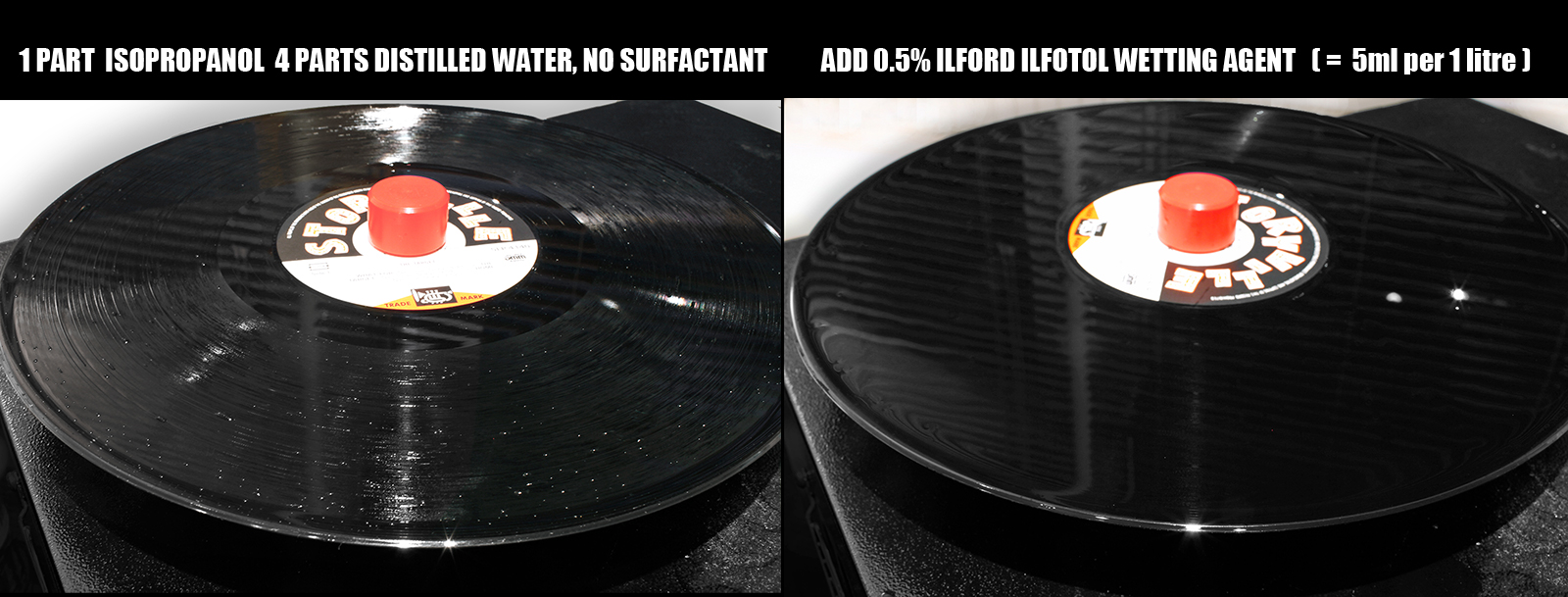
Ilford, a long-established British manufacturer of films, papers and developing chemicals, have been making “Ilfotol” wetting agent for decades, photographic professionals entrusting negatives from film shoots costing hundreds of thousands of pounds to wetting agent. The manufacturers data sheet recommends a start point dilution of 1:200 – 5ml per litre, equivalent to a teaspoon. Adding wetting agent changes how the cleaning fluid behaves. Spreading flat on the surface like glass, allowing the alcohol to fill the groove and do its job.
I tested half the recommended 5ml per litre of cleaning fluid and it still wetted, though a little more hesitantly. 5ml seems about the sweet spot.The “few drops” some people recommend is completely ineffective, and more than 5ml tends to result in detergent foam.
UPDATE April 2019 – Ilford Photographic have recently rebranded the Ilfotol wetting agent, however it remains substantially the same product, just under a different name and packaging.
Note: The US equivalent wetting product from Kodak, “Photo-flo” is specifically not recommended for cleaning records as it contains chemicals which remain as a coating on the surface, which will contaminate the stylus tip. I have no personal knowledge of its effects but it seems well documented, though as with everything, the internet can be an echo-chamber of misinformation.
Other helpful accessories and advice
Oral syringe
One tool which is essential in all record cleaning is a 5ml oral syringe (oral = no “needle”), costing about $1. Not only will it control the exact dosage of preparations like wetting agent, it ensures you administer the correct amount of cleaning fluid to the record surface : 2.5ml per side is exactly enough to get good coverage of the vinyl surface, controlling the delivery to keep it away from the label, and sufficient not to start evaporating during the few minutes of a cleaning session. Cheap and after a few months use, replace.

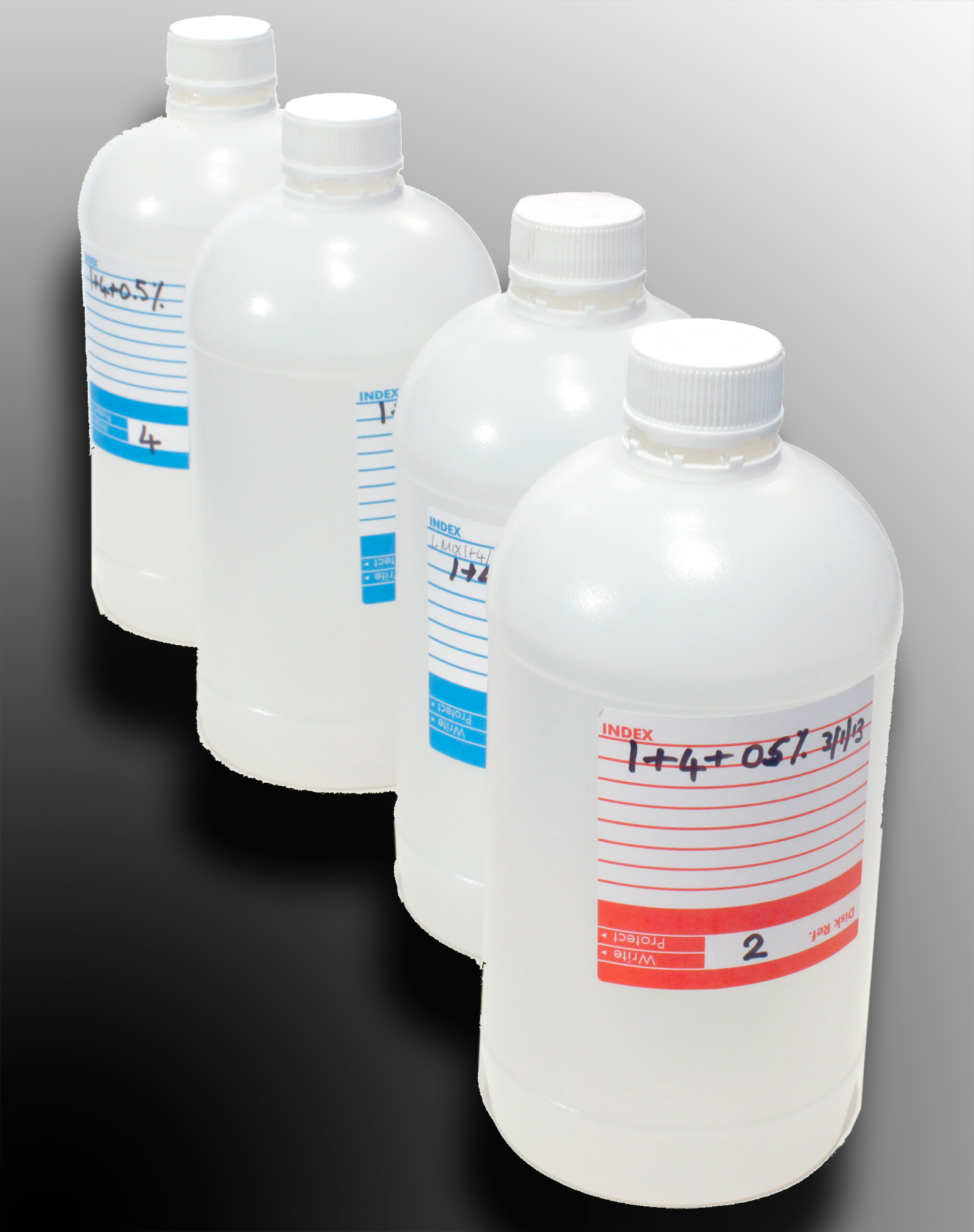
Five litres are good for a year or two’s supply, one-third of the retail cost of the cheapest proprietary commercial record cleaning product. Convenience and simplicity in a bottle, which should of course be suitable for storage of alcohol-based solvent.
 Cleaning Tips
Pour quantity required for current cleaning session only into intermediate reservoir such as small glass bowl, taking care to avoid spillage. Return any surplus unused cleaner to storage bottle at the end of the cleaning session. I find the glass rimmed and fluted ramekins that come with single portion cheesecake dessert have many advantages – the cheesecake is great, they hold enough for washing eight to ten records, and pour in and out without spillage.
Use wide soft brush designed for record cleaners purpose (available from record cleaning machine suppliers) to spread the fluid on the record surface and ensure complete coverage up to the label edge, but not onto the label itself. Don’t use a paintbrush which sheds bristles glued in by adhesive. Use of nail-brush or other scrubbing-function is not recommended – merely spread and allow the cleaning fluid to do the work.
Storage after cleaning: Ensure record is perfectly dry before returning it into an inner sleeve. I recommend using a fresh nagaoka-type inert mylar archival quality inner bag to store the cleaned record, within a new paper outer sleeve. New inner sleeves eliminates the risk of contamination from previous sleeve usage. You do not know what previous record owners have done- I’ve encountered some stupid things, like the one who used metal staples to mend split seams of the inner bag, which remained loose and unseen in the sleeve and deeply scratched the record grooves. Fresh inner sleeve = peace of mind. The white paper sleeve makes no contact with the record surface, no paper scuff or paper dust, and a useful place to write down important detail, and notes of your listening observations (audio quality, artist performances, stand-out tracks).
Benefits of vinyl cleaning – the evidence
Before washing:
.
After Washing:
.
The audible benefit of clean records far outweighs the small outlay and effort – fewer clicks and pops, reduced contamination of your stylus tip, and a subtle enhancement of clarity from the removal of fifty years of contamination – condensed tobacco smoke, greasy fingerprints, and manufacturing process by-product, mould release. I wouldn’t dream of not cleaning. Every record is cleaned before first playing, even if brand new. Many will benefit from a second even a third clean.
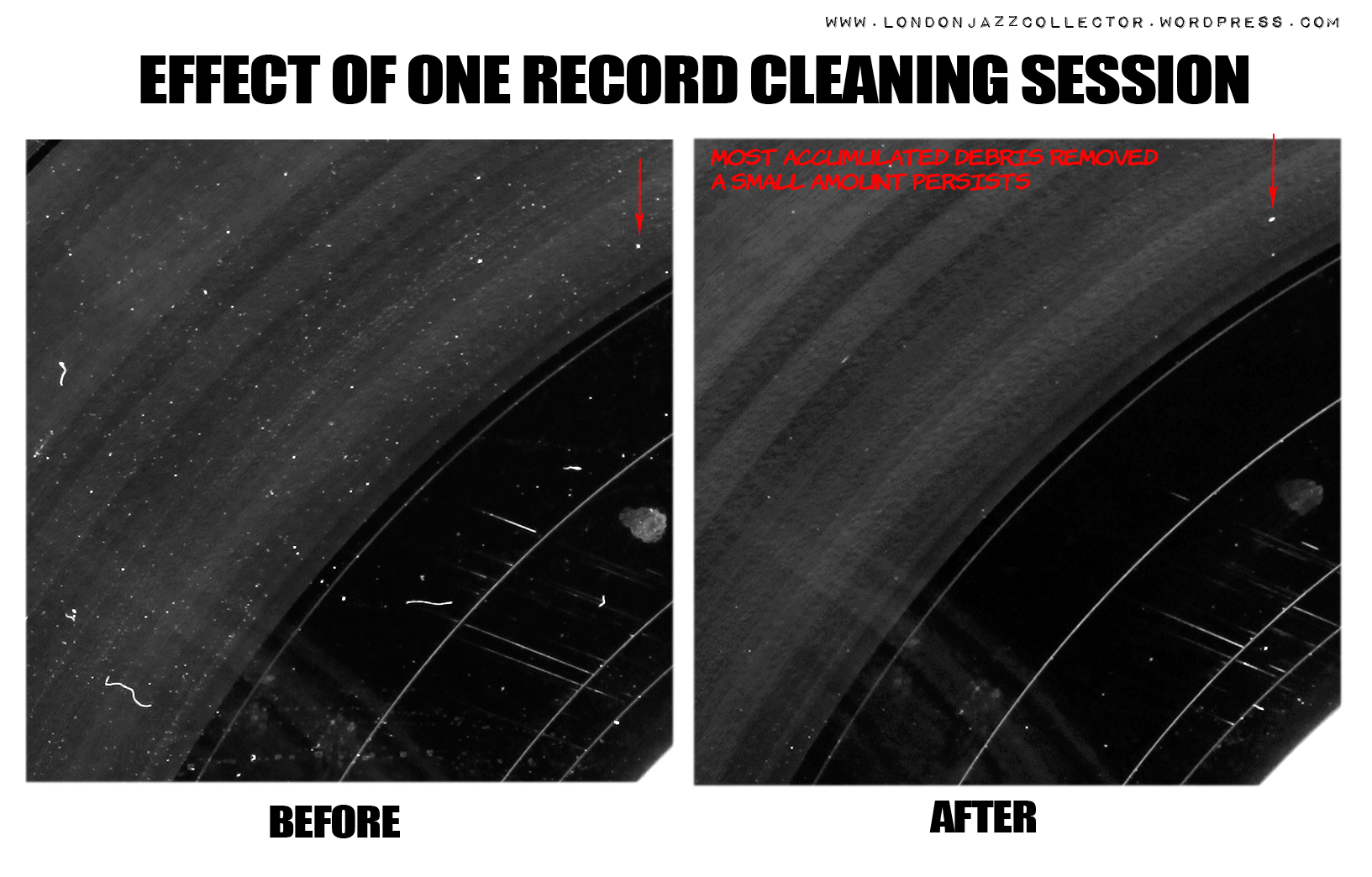
The only thing not removed by record washing is the occasional presence of small pieces of “grit ” wedged in the groove. These are the origin of random pops, which occur when struck by the stylus. These are best dealt with by lightly stroking the circumference of the vinyl surface with dry fingers prior to washing.
The only thing I can’t help you with is the cost of a vacuum cleaning machine. It is a one-off essential investment for anyone serious about listening to music on vinyl. Throw away the dustbug and the cleaning cloth which pushes muck down into the groove.Cleaning is not just about dust. Only wet cleaning/vacuuming ensures all contaminants are dissolved by the cleaner. The resulting solution and any dust is whisked away, leaving your record in optimal condition for playing.
One last thing – keep an anti-static brush next to your turntable to remove any airborne dust and static gathered during a playing session. Give it a couple of turns after the turntable has stopped (don’t stress your TT drive-belt by dusting while spinning) and returning the record to the inner bag and sleeve.
Controversy: can cleaning harm records?
You should be aware there has been a theoretical argument, written by a chemist, that exposure of vinyl to alcohol can cause leeching of plasticiser from vinyl, causing it to harden. The molecular chemistry theory is not backed up by any information on the practical concentration or length of exposure required to cause harm in the real world. As often the case, lazy academic advice is a counsel of perfection, without regard to quantifying the risk and benefits. They don’t care if you have dirty records, its not their problem, they have no solution to offer, quantifying things is difficult, but they have warned you.
Another argument I have read against alcohol in contact with vinyl is that it strips away “the protective coating of vinyl”(not meaning mould release) and that repeated cleaning with alcohol makes records sounds “harsh and brittle” leaving your records “permanently scarred” This from a respected Hi Fi journalist! Vinyl does not have a “protective coating”, it is just vinyl. Any “coating” would interfere with the translation of information at the point of stylus contact. You can’t strip away what isn’t there.
If playing a record with clean surface contact between stylus and vinyl groove sounds “harsh” (as they claim to have found in a “test”) they are experiencing serious confirmation bias and projection (I found what I expected). At worst, there is a trade off between the many benefits of cleaning and the theoretical potential for harm. However, fearmongering is rife on the internet. Your choice, it’s the world we live in, you have to form a judgement about what you trust.
Well diluted Isopropyl alcohol has been used for decades for professional cleaning of vinyl. Alcohol is an effective cleaner used by tens of thousands of vinyl lovers. You should be aware that there are vinyl-cleaning enthusiasts for whom isopropyl alcohol is the equivalent of holy water to a vampire. I have cleaned thousands of records with diluted alcohol and water based commercial cleaner over many years to considerable audio benefit and no harm I can detect. I don’t have any concern about a well diluted solution exposed to vinyl for a matter of minutes and removed by vacuum. A record needs to be machine-cleaned only once in its life.
Recipes which recommend ethanol, as used in commercial record cleaning products like Knosti, may suit those of a more nervous disposition. No doubt a chemist somewhere will find a theoretical risk with ethanol, which is why chemists don’t often get invites to parties.
What about cleaning Styrene records?
The plastic compound styrene was used as a substitute for vinyl in the production of records – mainly but not exclusively 45s – from the mid ’50s through to 60’s and 70s. Styrene was considered cheaper and more efficient than vinyl, at the expense of being more brittle, and more vulnerable to groove wear.
Whilst alcohol-based cleaning fluid is unsuitable for 78’s, the preferred method of cleaning styrene and vinyl remains the same. Both styrene and vinyl are derivatives of oil and petroleum, so they have a similar chemical origin.
Because raw vinyl is fairly rigid (think PVC plumbing pipes!) it had a chemical plastyliser added, to give it the flexibility needed to form record grooves. Plastyliser is known to be affected by contact with alcohol, though no one has identified scientifically what strength and how long an exposure to alcohol is harmful to the vinyl surface, it is a theoretical issue. In medicine, it is said that everything is potentially harmful, dependent on dosage. It is dosage – the quantity – that makes chemicals harmful, even fatal.
Prolonged contact with highly concentrated alcohol is probably harmful to vinyl, short exposure to dilute alcohol promptly vacuumed away, does more good than harm. I don’t find any more reason to be concerned about IPA cleaner on styrene than on vinyl. The best way forward is to try it on a very dirty styrene record you don’t much like, play before and after cleaning, and see what happens. It should simply sound cleaner and better.
Comparable Formula Commercial Alternatives – Nitty Gritty P2
“90% distilled H20, 10% isopropyl, and 2 drops of surfactant per one gallon of H2O. It is a necessary ingredient needed to break down the surface tension of the H2O – without it, the fluid mixture will not make contact with the bottoms of the grooves. Even this tiny amount could leave a bit of residue if not vacuumed off.” Michael Baskin, co-founder Nitty Gritty.
Comparable Formula Commercial Alternatives – LAST
“LAST Record Cleaning Machine Fluid contains 20% of Laboratory Grade Isopropanol. RCM Fluid also contains sequestering agents that prevent the alcohol from any adverse reaction with the record vinyl. The role of the alcohol is to dissolve contaminants and pressing residues and get them into solution and subsequently vacuumed away by the machine.”
Disclaimer: This recipe is offered in good faith, works for me and thousands of others, but because of factors outside of my control, you proceed at your own risk. For use only on vinyl records. Alcohol is potentially poisonous and inflammable: take appropriate precautions in handling, storage and use (as indicated on bottle of commercially-supplied Isopropyl alcohol) Keep away from naked lights, keep bottles capped at all times. Not for human consumption, if ingested accidentally seek medical advice. If ingested deliberately, seek professional help, but be sure to send me a copy of your tasting notes.
Happy listening.
LJC
 LondonJazzCollector
been using this formula for nearly 10 years. Today reading through the comments I realise that my Ilfotol might have gone wrong. However I have ultrasonically cleaned a bunch of singles with this formula and here’s the result:
LikeLike
I use biofuel now instead of Alcohol. It works a treat.
LikeLike
Any advantage in warming the mix a little bit in a microwave before using it? Wil the isopropyl in the mix be any more effective if its gently heated?
LikeLike
For several years I use this super cost effective formula. I’m still amazed how great it works. In 2016 a bought a bottle Ilford Ilfotol that I’m still using. Mind you, I took a empty clean wine bottle and let the bottle dry in the sun until it was totally dry. Then I took vacu vin wine saver to suck the bottle vacuum and to storen it completely airtight in a dark place. I also left some Ilfotol fluid in the original Ilford bottle. Today I noticed that Ilfotol fluid in original Ilford bottle turned milky white and had an odor. The fluid in the wine bottle is still clear and has no odor.
Anyhow, read the user manual of Ilfotol. Ilfotol doesn’t last a lifetime. Concentrated in full airtight bottle it will last 3 years and in half full tight capped bottle 12 months. That’s the reason why I used a wine bottle and vacu vin vacuum. Hopefully it will last me a lifetime of use.
LikeLike
I have just realised that my (almost full) bottle of Ilfotol is now ‘milky’… does it mean it can’t be used to make this vinyl cleaning solution? After all just a drop or two is used to make the solution. And I follow it up by a distilled water rinse. Please advice.
LikeLike
I want to thank you for this article. It was funny, interesting and useful. I made a batch using your formula and it worked fantastic. I have enough to share. Thanks again. -Grady
LikeLike
Hi,
I’m new to this forum, and cannot claim to be a jazz collector, but I have read your notes about record cleaning and want to say thanks for the recipe and everyone else’s comments.
I cannt afford/justify a vacuum RCM so have had to make do with manual cleaning using a DiscoAntistat bath. At first, with the Disco fluid, my test albums ended up with a large amount of gunge left on them – picked up by the stylus on playing – and looking like the sort of bacterial mat see in some deep-sea exploration films. Plenty of stylus cleaning needed! I stopped this cleaning method pretty quickly and ordered the ingredients you stipulate, hoping for better results.
On first trying your recipe I got a similar result, and wondered what I was doing wrong (apart from not shelling out for the vacuum RCM) !
Then I cleaned some of the mucky ones plus a few others (about 12 in all) in the ‘disco’ bath and followed up by rinsing them all in distilled water within 1 hour of the IPA-based cleaning, and left them to dry for 24 hours.
Success! I have done over 20 now and they have all come up really well, with results similar to those reported by others. I cannot say the outcome is as good as with a vacuum machine, but I am recording and digitising each album and can see the signal waveform on screen and can say that inter-track noise levels are lower than before (fewer clicks and pops). Also, I use the ‘Dustbuster’ stylus cleaner stuff between each album, just in case, and there have been no visible deposits left on the surface since adopting this new cleaning procedure.
In fairness I should also try the DiscoAntistat fluid again with a distilled water rinse afterwards, and when I get around to this I will come back with my results.
So, for those who cannot yet get a a vacuum RCM, and are willing to take the time and effort to clean and rinse as I have done, I think you will get worthwhile results.
LikeLike
I’ve been using your recipe for years and I can truly say it works a treat. Thanks for sharing!
LikeLike
Hello,just a quick question,how can I remove picks gunge on my stylus that I bought brand new (ortofon blue) a few weeks ago?I damaged all my records with cleaner washer fluid.Could you help me with an advice, please, thank you
LikeLike
In what way are all your records “damaged”? What sort of cleaner washer fluid does this? What make and kind of record cleaning machine or device to you have? I have never heard of such machines damaging records. You have to tell us a bit more.
Records are best cleaned with a record-cleaning machine with a vacuum suction function which removes the fluid and and any contaminant dissolved by the fluid. Better still, but more expensive, ultrasonic cleaning machines.
If you have “gunk” transferred onto your stylus tip, there are numerous stylus cleaning products – I recommend
Lyra SPT. It has a formula which is said not to weaken the bond between between the stylus and the cantilever it is mounted on, which is the big hazzard.
LikeLike
https://www.avstore.ro/accesorii-pick-up/audio-technica-at607/
LikeLike
I’m wondering if this recipe is suitable for ultrasonic cleaning machines?
I have an Okki Nokki RCM as well and planning on using that for a rinse step.
LikeLike
Short answer, I don’t know. Ultrasonic machines are designed to use pure water, fire tiny bubbles at the vinyl surface. They are not designed to dissolve contaminants, which is what this RCM formula does. If IPA does any damage to the internal parts of an ultrasonic machine, it is kind of expensive way to find out.
LikeLike
The manufacturer of my ultrasonic machine I’ve just bought has this receipe:
“Isopropyl Alcohol 96%- 0,7 litre (available in stores)
Demineralized water – 4 litres
Mirasol liquid (TETENAL) or Ilfotol (Ilford) – 10 mils.”
So I guess I’ll modify the ratios to use yours. There is much less surfactant in their receipe.
LikeLike
I built my own ultrasonic RCM using the iSonic tank (7.5L?) the same tank that Kirmuss uses in his proprietary system. BUT… in building my own, I can control the chemistry (which is what you are asking about) the temperature, the number of records cleaned on a customized spindle at a time (6 across a 10″ tank, allowing about 1 1/2″ space between each record) and at half the cost : ) FAR more effective in my lowly and wretched opinion (and you don’t have to do all the insane ‘after-cleaning’ that he does)
The only thing that you MUST be careful doing with the ultrasonic tank IF you use heat is you must keep your IPA (99%) to 5% or less of the total solution, due to its inherent flammable qualities. At 5% you should be fine, so that is the only critical thing to change from the fellow’s excellent formula above. These are the proportions that I use:
ILFOTOL: 10 mL per 2 Gallons
IPA: 200 mL per 2 Gallons (approx <1/2 cup)
Triton X-100: 8 mL per 2 Gallons
I add the Triton X-100 merely to enhance the surfactant properties. Actually, I’m adding the ILFOTOL primarily as an antibacterial so that the water supply, which I run through 2 filters in series (1 – 1 Micron & 1 – .35 Micron) and the water in the lines and in the pump will stay clean.
Here is a video and a couple of recent updates if anyone wishes to check out how I made mine. I describe the way it’s put together along with the rotation speed and duration, etc. I also recently added an additional distilled water rinse tank to rotate the records in immediately after the US cleaning in order to ensure no residue is left on the vinyl (that way I don’t have to use my vacuum/rinse RCM on each one afterward : )
LikeLike
Hi, A lot of talk mostly with regard to the groove potion of lp records. I have not seen anything on the problems with 45rpm record’s labels that show a whitish coloring on the label itself. No information on how to clean that off.
LikeLike
Are y’all still rinsing records after the clean when using this formula? Not sure if the rinse will help or not – if anyone’s already experimented, I’d love to hear the results…
LikeLike
Yes, from what I have researched and read, a final distilled / lab regrade purified water rinse would be advised to ensure that no residue is left. When I need to give more attention to records that are more stubborn than usual (I’ve done nearly 2000 records with my DIY ultrasonic that I mention above, and all have come out very clean and quiet with only the exception of maybe about 25 or so where I need to employ the method our host describes above.
But, after using a similar formula to his and a good vacuum (also DIY : ) I ALWAYS give a record a lab regrade #2 purified water vacuum/rinse (distilled would be fine though)
LikeLike
Dear LJC,
I recently purchased an early ’70s Prestige “twofer” reissue of two early Miles Davis albums, “Cookin'” and “Relaxin'”. I have found many of these twofers to be very good value, particularly the ones remastered by RVG, as this one is. And indeed the sound quality to my ears is quite good, and mostly free of the annoying pops and surface noise that often comes with original late ’50s/early ’60s pressings (at least those whose condition brings them within my limited budget).
“Mostly free,” because here’s the catch. While sides 1, 2, and 4 have nearly pristine sound quality, side 3 is mysteriously plagued by mid-level “static” (surface noise) throughout. I have cleaned the vinyl and for the life of me, I can’t locate any apparent source of the noise on the record’s surface. The opposite side of the record (and both sides of the other record in the set) are fine.
Any theories on what might be causing this? I’ve heard that vinyl records contain trace elements of metal that sometimes can become magnetized; could this be the source? And if so, why wouldn’t the other side of the same disk exhibit the same problem?
Any advice, moral support, or indeed wild speculations you can offer would be gratefully received.
Thanks again for the terrific work you do with this blog!
All best,
CJP
LikeLike
This problem has frustrated me for years. I don’t have a definitive reason for it, though I do know that records played with worn or mis-aligned needles can suffer from groove damage. However, when it is only one side out of four, this seems unlikely.
LikeLike
Well, it is arguably the best side ….
Based on my very limited knowledge and experience, it seems to me there are only two likely explanations for this phenomenon:
The cause of the problem occurred in pressing — there was some flaw in how side 3 but not sides 1, 2, or 4 was pressed. I don’t know enough about the mechanics of the pressing process to speculate about what this might have been.
The cause of the problem occurred later, in use, perhaps when a previous owner of the record applied some caustic cleaning agent to side 3 but (perhaps realizing his/her/their mistake) not to sides 1, 2, or 4. The fact that side 3 shares a high gloss and generally pristine appearance with the other three sides seems to militate against this theory.
At present I lean tentatively toward the “flaw in pressing” hypothesis. But I am quite sure there are many reasonable possibilities I haven’t thought of. Maybe even some obvious ones.
LikeLiked by 1 person
I’ve had a few similar instances with albums that have one or two “problem sides”… Conventional logic would probably assert that those sides were played more, but in classical pieces, I don’t see that happening. (Somebody only liked the 4th disc, side A of the Messiah?) I have heard, what seem like, reputable arguments that static charge can cause issues with vinyl records. I’ve been considering buying an anti-static gun for these problem discs that seem to sound damaged regardless of cleaning. https://www.amazon.com/Milty-5036694022153-Zerostat-Anti-Static-Blue/dp/B0033SHDSS
Thoughts?
LikeLike
I bought a zero antistat gun. Despite the impeccable logic of removing static, I have never noticed the slightest difference or improvement before and after use.
LikeLike
We have all had records which appear spotless to the naked eye, but have an irritating level of random surface noise, clicks and pops that likely have their origin in “dirty” pressing, not subsequent owners miss-handling. Why some (unknown) plant and not others, who knows.
For it to be apparent on just one side of four points to miss-handling of one of the stampers during pressing. Maybe it wasn’t fixed properly in the press. My recent post on stampers reminded me how vulnerable mechanical processes can be to faults. At the end of the day press operators were fallible, plants were not laboratory-clean, it is a miracle so many “sound great”™
My first step in cleaning a vintage pressing is a firm finger-pressure sweep carried out in revealing light – direct sunlight reflection or LED – to shift resistant spots of clinging debris, prior to ultrasonic cleaning on the maxim number of cycles you machine offers.
Beyond that, offer prayers, little else offers hope.
LikeLike
Thanks, LJC. Sigh. Well, I really didn’t pay much for this set and 3 of the 4 sides are great. The side in question is S1 of the release originally known as “Cookin’ with the Miles Davis Quintet,” so I guess I’ll have to keep looking for a good copy of that record.
LikeLike
Hello, As a long term user and referrer to you recipe, I just thought I would let you know that Ilford does a much smaller Ilfosol, disguised under their new ‘Simplicity’ range at 25ml. They are currently out of stock mind.
LikeLike
Hello all vinyl lovers. I have been cleaning vinyl for a few years with ultrasound and a 3/4 -1/4 liquid formula with ilfotool 5ml per liter, rinsed with distilled water and dried with Kuzma RCM. I notice that the LP is not equally cleared from the beginning towards the middle. towards the middle is less cleared. since my cleaner (sink only) costs (chinese) € 250, I added the motor and the pump with the filter myself. I cleaned the plate at the dealer on the scrubber (elma) for € 1800 and found it to be the same so the dealer looked at me incredulously but slowly made sure I was right. this is due to the height difference lp in the trough of the cleaner. i ask you if you noticed that too. sometimes we are less objective because of our enthusiasm.
LikeLike
I just finished my vacuum wand project yesterday. A piece of 22mm white plastic pipe left over from a plumbing job, cut in two and made into a 12″ and 7″ wand. Two rubber stop ends left over from installing garden lighting. A clapped out deck rescued from landfill. 6m of velvet tape and 6m of double sided tape for around £7. A wet/dry shop vac for £25. Cleaning solution made to this recipe. So far I’ve cleaned a couple of John Lennon albums almost 50 years old, (Imagine, Some Time in New York City) with horrible surface noise, restored to listenable, though still clicking and popping due to physical damage to the discs. Bowie’s Scary Monsters 1st pressing sounds close to new. Bob Marley’s Confrontation 1st pressing was in a terrible state when I listened to it the whole way through before cleaning. I’ve also tried a couple of my original Queen albums, and a few 12″ singles. All have had remarkable results. I applied the solution and left it for around 5 minutes or so on each sound and the difference is unbelievable. These were all records I was considering donating to goodwill before I saw this site and watched a few youtube videos on how to make the vacuum wand.
The only thing I’m not quite sure about is exactly how much solution to use per record side, and how long to leave the solution to work before drying. I’ve stopped short of completely soaking them so far and I am very happy with the first results.
LikeLike
Hi, Any testing with the AGFA formula Agepon now found in the WAC wetting fluid? Thank you.
LikeLike
As an alternative to Ilfotol, I did quite a bit of research and found that wetting agents are added to insecticides. These can be brought seperate to the insecticide, thus in this case it is almost 100% Tridecanol. The advantage being that it is available in much smaller quantities. I will test the mixture in my Spinclean and report back if it doesent work.
LikeLike
I see this is an old article so I hope you still read the comments. I messed up and bought 70% Isopropyl Rubbing Alcohol (I blame Amazon lol). Could I just change the percentages and use more of the Isopropyl? Or is it not that simple?
Also I have been looking around and the cost of distilled water is shocking! I have seen a water filter product called zerowater on Amazon. It claims to produce distilled/purified water. It looks pretty good and could save a fortune. I think it’s good enough for me. What are your thoughts on it experts?
I am a beginner to Vinyl so not looking for audiophile results necessarily. Thanks for the useful article.
LikeLike
I have been using 100% Denatured alcohol in my mix in the same amount as for Isopropyl. Testing a small batch on junk records, l do not hear or see any difference. No noise or damage to the vinyl. If you prepare a suggested 5 liter batch, you will have enough record cleaning fluid to last for several years. You can cut it down to 1/5 the amount of each ingredient if desired. This was what I did to make a test batch.
I haven’t put a dent in my supply of solution. I store it in a dark closet. I bring out a small container then use a syringe to apply 2.5ml of solution to each side. At this rate, do the math, you can clean a ridiculous number of records, even if they need 2 or 3 passes per side, in cases of thrift store acquisitions.
I too was hesitant at first. Then I decided to dive right in and ordered the Ilfoto from B&H Photo supply here in the US. 20$ and free shipping I had it in 2 days. While waiting for the ILPHOTOL, I picked up the distilled water, and 99.9% Denatured alcohol AND the 1 liter bottles from a local Home Depot. This cleaner solution works a treat. I’m using my VPI 16.5 with Disc Doctor felt brushes. Records have never been cleaner or as quiet. Scrubbing with the machine is faster and easier than before. I use less elbow grease and cleaner than ever. The solution is dirt cheap and just as good or better than the stuff you buy commercially. More money saved can be used to buy new vinyl or update your cartridge or other parts of your kit.
I use several brushes, keeping dedicated brushes for new or like new records, others for thrift acquisitions, the first pass clean, or final rinse pass etc. I number them to keep them in order and wash them before and after each cleaning session. Most records only need one pass and no rinse. All rinsing does is add more static. Any remaining fluid evaporates, leaving the surface clean and dead quiet
A for vacuuming dry, 1 1/2 rotations is sufficient. Too much vacuuming generates excess static
adding noise on the vinyl surface, immediately attracting dust and garbage from the room air to the just cleaned LP. I like to a few moments before playing,.. play the side dried first to be sure the grooves are dry, OR insert it in a clean rice paper inner sleeve before returning to the jacket. Do not use polyethylene inner sleeves, as damage will result to your vinyl. The stuff was used for years and now we’ve discovered it ruins our precious vinyl.
ENJOY!
LikeLike
I have a TDS Meter (Total Disolved Solids) bought Cheap on Ebay. I use it to test my water softener, and RO (Reverse Osmosis) Water. When testing, the best you can hope for is 90% RO efficiency with a home unit.
The test results are Softened water 1100 ppm TDS, My RO Water 125 ppm, Distilled water .001 – .005, no contest which is the best! Here in Manitoba Canada, I can purchase 23 Litres of Distilled water for $6 (Take my own Pail)
Check to see if any of your bottled water suppliers have distilled water, way cheaper than the 1 gal in the store. (Well here at least)
Yes 99% Isopropyl alcohol is readily available in Canada, 500ml $6 at Costco. and other Pharmacies. It is kept behind the counter not available out on the floor shelves. Further 70% isopropyl COULD contain lanolin as this mixture is commonly referred to as RUBBING ALCOHOL! I use the paint pad method and have been happy and no ill side effects!
LikeLike
Very interesting about RO, I’ve never heard of that measure of water purity, thank you. A friend told me reverse osmosis water, as supplied for fish tanks, is “the purest water you can buy” (at a fraction of the cost of gold standard triple-distilled). It seems RO is 90% “cleaner” than tap water. The question must be whether that last 10% is worth about ten times the price of RO water. I’m thinking homebrew – half RO, half distilled. Could be a good compromise!
LikeLike
I was careful to follow the recipe to the letter. 5ltrs 99% distilled water, 99% isopropyl alcohol and ilfotol. Prices are ridiculous. One company wanted to charge me £15 to deliver 5ltr of water. They must’ve caught on that record collectors are using these ingredients. Its just as well the results are excellent.
LikeLike
As a sense of perspective: I called up my local pharmacy (in Germany that is) and they ordered 10 litres of double distilled water for me (this is the water you use for medicine, lotions, etc.) and told me on the phone it will cost 12 Euro.
They also told me they can order Isopropyl, which would be around 10 Euro per litre. This seems more expensive than what I can find on eBay (around 3 Euro per litre), but would of course give the convenience of picking everything up at one place in town. I’m kinda undecided though and will talk to them once more upon water pick-up.
LikeLike
As a sense of perspective:
I find 12 euro for distilled water expensive. In the Netherlands it costs about 3,50 euro (https://www.diodrogist.nl/chempropack-gedestilleerd-water-5-l)
Also I find isopropyl for about 10 euro expensive. Once again in the Netherlands is about 5,50 per liter (https://www.deoplosmiddelspecialist.nl/kopen/isopropylalcohol).
Bio Ethanol is about 25 euro (https://www.bioethanolshop.nl/bio-ethanol-100.html)
LikeLike
Hey,
I don’t know if Google Translate does a proper job in translating this to English, but if it does, what you linked to is Distilled Water (which you get at every Supermarket). This is also around that price in Germany. What I meant for 12 Euro/10 Liter is so called double distilled / purified water which you get either online or at a pharmacy. To be fair I don’t know if there is a real meaningful difference in the two. However, at the end the price difference is only 5 Euro. As your link is 3,50 for 5 liter so 7 Euro (10 L) vs. 12 Euro (10 L).
The Isoprop. is also cheaper, you are right. Still I find it quite ok given that 1 L Isoprop. will render 5 L of cleaning fluid, according to this recipe, which should according to the article above, clean around 1.000 records (2.5 ml per side). 🙂
LikeLike
FWIW, I don’t find that Isopropyl Alcohol has enough solvent action or bite to get my records as clean as they could, even with repeated passes. Denatured Alcohol (99%) works best for me. The Dirt Doctor brushes now sold by Mobile Fidelity (they have hands in everything it seems) seem the safest to use while digging deep into the grooves and not damaging them or adding noise from scuffing. I scrub hard on the first pass. A second pass is obligatory, and I always clean an LP before play, no matter how clean or how many times it’s been cleaned. it won’t hurt the vinyl, and they do get quieter as you play them, digging out random junk really deep. New vinyl isn’t always a guarantee to be quiet either, even expensive 200 gram 45 RPM pressings. Clean, Clean, Clean.
I’ve noticed over the years some cartridges are naturally noisier than others, bringing surface noise to the fore. Personally, I found the Sumiko Blackbird one of the quietest out there with decent output at 2.6mv, and really good sound. I recently mounted one on a (new to me) VPI Prime Signature TT, clean dead quiet records, a great cartridge on a superb table, I’m in analog heaven,…many thanks to the home brew recipe..!
LikeLike
One more thing. I notice there isn’t a ‘rinse’ stage mentioned. Does that mean that thee is nothing left behind after vacuuming the cleaning solution off? Should I mix up a batch of distilled water and Ilfotol as a surfactant, so the distilled water will penetrate, thus any remaining cleaner or contaminants float and are vacuumed away? I’m using a VPI 16.5 with the VPI velvet lips on the suction tube. The brushes I use are from “Disc Doctor” ,essentially velvet on rubber “T” holders. I also have the included VPI nylon bristle brush which came with the VPI 16.5. Are these brushes soft enough when wet to not cause damage or scratches in the deadwax, lead in, grooves, or surface scuffs on the play area? I know there is a fine line between applying too little and too much pressure when scrubbing with the machine off and the record wet.
As far as drying, I try to keep the vacuum on one – two spins maximum to remove the dirty cleaner. This leaves some moisture on the record, noticeable in the deadwax, so some cleaner must be left on the surface and in the grooves. Would leftover cleaner leech into the vinyl, perhaps cause noise when playing? How much vacuum time is recommended using this formula? I know too much causes excess static build up hard to remove. Even the Zerosta and carbon fiber brusht I have wont remove the excess static. Only time in a rice paper inner sleeve with time seems to remove unwanted static buildup after vacuum cleaning
Thank You in advance.
LikeLike
I’ve been using this recipe for over 5 years now on hundreds of records, with a KAB manual vacuum cleaner. I just realised I’ve never thanked you. So, thank you!
LikeLike
Yeah, the vacuum should leave the disc completely dry. Just turn the platform the disc is on slowly until all of the solution is gone from the playable area. If there is any left around the outside of the disc, just wipe it off with a microfibre cloth. I’ve found that the wand lifts off the spindle while I’m turning the platter, so I press my thumb down gently on that end, and put no pressure on the other end. This allows the suction to do its job properly.
I use a 1″ wide, flat paint brush from Ikea to apply the solution and it does a brilliant job. Others recomment paint pads, which can be bought in any diy store for very little cost. I use 9mm wide velvet strips on my wand and they do a wonderful job lifting the dirt and solution. And they are completely dry when I stop the vacuum.
LikeLike
Any wetting agent (surfactant — a portmanteau of “surface active agent”) in the RCM solution will concentrate at the solid/liquid interface, otherwise it would not work as a wetting agent. This is a temporary surface modification. It means that even after vacuuming up all of the liquid, it is likely that some amount of surfactant still adsorbed on the vinyl surfaces. Therefore, I rinse with pure water (distilled in my case, as additional purity in this application is inconsequential) until the water is observed beading up on the vinyl.
LikeLike
Hi. I`ve been using this mix the latest year with good results. Thanks for the information!!!!!
LikeLike
Can you use 99% denatured alcohol instead of IPA? I have gallons of it and hate to buy something else if I don’t need to. Interesting that your formula uses no detergents, like Faery or Dawn dishwashing detergent. Typically, 2-3 drops are added in other formulas, including one’s I’ve tried. Thanks for your help!
LikeLike
Have been using this recipe for more than 3 years with exceptional results!!!
Using an Oki Nokki washing machine and making sure that the pads on the sucking pad and the brush are clean, and in good condition, can resurrect old filthy records with amazing results.
Thank you, it works wonders!
LikeLike
Anyone tried this formula with an Ultrasonic cleaner?
LikeLike
Only if you are content to write off your ultrasonic cleaning machine guarantee. Audiodesk (my ultrasonic) require use of their proprietary detergent-based concentrate only. Anything else and it’s void. That aside, it works on completely different principles. Some people have said alcohol-based vacuum cleaning and ultrasonic cleaning each make a slightly different contribution, and they use both, in a two step cleaning process. Could make sense.
LikeLike
I have a DIY UltraSonic solution so no fear on the warranty side!
LikeLike
That’s ok then, you could do worse than give it a try. I can’t as the Audiodesk Pro is known to have a certain “failure rate”, judging by comments made to me. (I’ve had no problems myself)
LikeLike
I have mail ordered one set of vinyl records clamp and small motorized rotary device and stainless steel Ultrasonic Cleaner Bath, (inside measrmnt: 30×15×10cm made in China costing approx. $250). Now that I got your receipe it will soon be operational when it arrives. My problem is how to vacuum clean the cleaned records. Many vinyl lovers (incld. Michael Fremer) advocate ultrasonic cleaning as a good and safe way to clean vinyl records thoroughly. There are also some advertisements about one complete set of ultrasonic cleaner kit, ready to use. As I live in Indonesia far away on the other side of the globe from America ordering such ready set from USA would be costly and cumbersome (because of the impossibly complicated official custom procedures in Indonesia). So I ordered only the small clamping and rotating parts from USA (still had to pay $70 custom tax) and buy the 6 litres china made ultrasonic cleaner bath from one domestic online company, costing ca. $250. And now is the problem with drying the clean but wet vinyl records. I can let them dry by just put them vertically in array on dish stander like in the kitchen. Or I can blow them dry with the help of ordinary elevtric fan, or with an air compressor and a fine air filter to prevent oil or dirt particles get through and destroy the grooves on the vinyl disk. Of course there are commercial vinyl record vacuum dryers on the market but it would cost you some more dear money. Maybe you could suck the wetness on the vinyl disk with an ordinary vacuum cleaner but you should use a very clean sucking head with fine and flexible brush to prevent damage on the delicate vinyl surface.
LikeLike
I use the ultrasonic method adding the cleaning fluid from above and then use a VPI HW-17 for a final rinse/vacuum/dry.
LikeLike
I can’t assist you with the unaffordability problem.
In other matters I recently was looking for stuff, and the best value for money came from the most expensive products. It costs time, money and materials to make good stuff, that’s why they do it. The cheaper products were the worst build quality and worst value for money. But they were cheaper.
Consider what other priorities are consuming your resources? When someone questioned how I could afford an X, it’s very expensive (inference, you must be very well off) I said my 21 year old car was recently valued by “We By Any Car.com” at £160. I finally got rid of it altogether, not replaced, saving £1,000 a year in tax, insurance and maintenance.
Priorities. That’s how. Music is more important to me than driving to the supermarket. I walk.
LikeLike
Sir, after two or so hours searching through surfactant manufacturers websites, translating various MSDS back to “Isopropyl blah blah, surfactant blah blah” I come across your wonderful recipe and forthright common sense advice. At bloody last, THANK YOU ! !
D. Y.
LikeLike
Judging from the many posts on the subject I can see many people are cleaning their records. Whatever method you employ one of the main benefits is that you prolong the life of your stylus, and that can be a major cost saving.
LikeLike
Pingback: Time to wash some records – HomeCoffeeCode
Mixed the recipe as per your instructions and tried it out on a really dirty copy of The Faces, A Nod’s as good as a wink to a blind Horse I found in a charity shop, played it on my Garrard 401 prior to cleaning and noticed an audible difference after cleaning with the solution, pops and Clicks almost eliminated, i used a spin clean machine and a lint free cloth as I do not have a vacume machine. It’s on my wish list 😊
LikeLike
how much of this solution do you add to the spin clean? and do you do a 2nd rinse?
LikeLike
Also, for those of you without a vacuum-based cleaner, several people on Ebay are marketing affordable manual 3-D printed cleaners that hook up to the hose of any vacuum with a hose attachment. Some are just wands that you attach and use your own turntable, others come with a ‘lazy suzan’ platter for you to place your record on.
There’s also the Record Doctor V, which is a licensed copy of the Nitty Gritty without the frills. It does a great job, I personally use one. What I like about it and the Grittys over VPI-style units is the smaller, unobtrusive size. I keep mine next to my turntable. I also like that you don’t recontaminate a side that you just did by flipping it onto a platter that you’ve just placed an unclean side on.
LikeLike
I just purchased one of the ones on EBay (The one with the platter and 3D printed parts). After using it I’m amazed at the great job it does and I’m retiring my spin clean.
LikeLike
Hi would you have a link to one of those on eBay? Cant find them/ don’t know what I’m looking for! Cheers
LikeLike
I know this is old but people might be stil looking… I bought a SqueakyCleanVinyl version in 09/2019 to use with a ShopVac and am very pleased with the results.dave
LikeLike
Much of the confusion over whether or not to use alcohol stems back from an earlier era in record collecting, pre-dating the LP vinyl record. 78 RPM records should NEVER be exposed to alcohol, it breaks down the shellac-like material of which they are made. It does no harm to vinyl whatsoever, but you can imagine how these sort of things propagate through the decades.
Photo-Flo, to my knowledge, causes no harm whatsoever. Again, the claims that it is harmful stem more from marketers of record cleaning formulas and certain enthusiasts who don’t believe anything is any good unless they shell out a premium price for it.
I myself am marketing a record cleaning formula for those not keen on DIY. Some people just don’t want to bother, or feel better shelling out $10 for an image in their head of a group of fanatically meticulous people in lab coats in a special clean room painstakingly brewing up a magical batch of record cleaning elixir deep underground in a top-secret location.
LikeLike
This may have been asked already, but what if you don’t have the vacuum based cleaner?
Wipe with microfibre cloth and dry on rack?
LikeLike
I have a Knosti spin cleaner and use the fluid in that then dry on a rack. Have been doing so for a number of years now and am happy with the outcome.
LikeLike
Washing alone I guess does some good, but it is like saying you want your house to be clean but don’t want to buy a vacuum cleaner. Vacuum suction draws off contaminants dissolved with the cleaning fluid. Leaving the fluid to evaporate /air-dry leaves everything behind in the grooves. It is not a good way to achieve the result we want: clean records. Though a vacuum RCM may seem expensive outlay, I think of it as an important component in any hi-fi, and wouldn’t be without it. .
LikeLike
I’d say wipe with a micro-fibre cloth, then wipe with another micro-fibre cloth, then another. In my experience you can tell when an LP is truly dry as you wipe manually, the cloth starts to ‘glide’ round the record with absolutely no resistance. I personally use 100% pure cotton face wipes, and that way know for sure that each wipe I’m using is 100% dry and clean – I can get through quite a few when I’m having a cleaning session………
LikeLike
I’d also add that air drying is basically only doing half a job……..
LikeLike
Hello there! Thank you for providing this recipe! I’ve been using it for a while with great results. I was curious as to how long you leave the solution on the record before removing it. For my really dirty records, I would do two applications but then rinse with distilled water. What has been your experience for those really dirty, oily, fingerprint encrusted records? Mind you, we used to DJ years ago so a lot of our records are like that. Thank you!
LikeLike
Hi, on my Moth RCM, I do three revolutions clockwise, three revolutions anti-clockwise, then flip it over to vacuum dry the underside while soaking the B-side for the 3+3 revs. a bristle brush keeps the liquid evenly spread. Cleaning fluid vinyl contact time from first wetting to bone dry is around four to five minutes.
I always watch the fluid during the first rev, to see that it is wetting well into the groove first time around. Mostly it does it, on a very greasy record which has had a lot of handling, or used as a pizza base, who knows, I’ve seen the vinyl “resisting” wetting in. Can take three turns before the fluid is glass-like across the surface and doesn’t form rivulets and shrink back. If that happens a wait a couple more turns.
This is a fairly labour intensive process, Masterchef, not flick-a-switch and forget.
Make sure the record is bone dry before returning to sleeve, and not over-dry, which generates static.
LikeLike
Sounds like I may be overdoing it a bit.
I’ll definitely try your method. Thanks!
Eddie
LikeLike
I have always been a strictly manual cleaner myself – spray on the cleaning liquid, spread with a record cleaning brush, then dry with two or three new cotton wipes, and this has always given outstanding results. I firmly believe that the actual key to record cleaning is getting the cleaning fluid off the vinyl as completely as possible once it has done it’s dirt loosening work. And a regular observation has led me to doubt the efficacy in this regard of cleaning machines. The reason I say this is I frequently buy LPs off Ebay which have been advertised as cleaned on ‘professional vacuum cleaning machine XYZ’, and generally I can tell if the seller has been telling the truth or not because using my manual method on these records I very regularly get a slightly foamy reaction either when I spread the solution over the LP, or give it the first drying pass, or both. So the only conclusion I can draw is that the machine has not removed all the residue effectively. If I’d only seen this once or twice I’d put it down to either ineffective use of the machine, or a poor quality machine, but the fact I see it regularly suggests that ‘vacuum cleaning machines’ aren’t quite as ‘vacuum’ as they profess……..
LikeLike
That’s an interesting observation, one which I’ve not heard before. It begs the question that when sellers say a record has been cleaned on their VPI or whatever, no-one says what cleaning fluid they use. Fairy Liquid? People have different commercial formulas, home made formula, water+detergent-based fluids have their adherents who are averse to alcohol (alcohol evaporates off very nicely, detergent not so much)
For a Moth RCM it’s important to renew the pads frequently as it loses suction when they wear, and I now use four album rotations each way to ensure a record is bone dry.
If anyone cuts corners – lets face it, record cleaning can become boring – I’m not surprised you get an unsatisfactory residue. I re-cleaned a record with an excess of “pops” previously “finished” in L’Art du Son, and was shocked how much junk that detergent based fluid had left behind.
LikeLike
I think LJC you’ve hit the nail right on the head, whatever process/machine you use record cleaning really is one of those ‘if a job’s worth doing at all, it’s only worth doing well’………..
LikeLike
Do you have a solution for an Amari RW 660 I would appreciate any input thank you
LikeLike
Hi, Are the people that have experience with 100% Bio Ethanol to make a record cleaning mix? I saw a German company that sells 100% ethanol with very small amount (10ppm) of Bitrex.
I found that the mix with ethanol works better than using IPA alcohol. In my experience I noticed that ethanol gets the dirt and grease better out of the grooves. Plus, bio ethanol is much cheaper than IPA. But 100% ethanol uses Bitrex to denatured the alcohol for consumption. Bitrex is a acid as we all know. So how much damage can it do even in very small amount (1 liter Bitrex is used for 100.000 liter ethanol).
Hope to read some experience from you readers.
LikeLike
I’ve also considered ethanol, but am concerned about the additives. Would be interested to also know the answer to your question. Also wondering what other types of ethanol people are using?
LikeLike
I used bio ethanol on a old fairly clean record and the results are fine. I used 250ml bio ethanol / 750ml distilled water and 5ml Ilford ilfotol. Then dried the record under the ‘cooker hood’ (is that the correct word for it? I’m Dutch btw). Anyhow I turned the exhaust cooker on high. After 2 hours the record is totally dry.
Because I use the Knosti washer with a modified clamp from highqual.uk (http://highqual.co.uk/modified-clamp-pics/4580316614). With the modified clamp the labels don’t get wet. With the standard Knosti clamp I assure you for 100% that the labels will get wet. The modified clamp resolves that issue totally.
LikeLike
Your concoction is absolutely perfect. Previously I’d been using paint stripper and attacking my records with a buffer attachment to my electric drill!
Have replaced your recommendation of Ilford Ilfotol with Tetanal Mirasol 2000 Antistatic (a German wetting agent). I made up a solution of 200ml using slightly less than 1ml of the wetting agent. The results are just superb.
Thank you so much for your advice & recommendations.
I was concerned that such a low concentration of IPA would be problematic, not clean effectively & take an age to evaporate. This is definitely NOT the case & I’ve found it utterly perfect.
PS Why do folk still use and sell polyvinyl & polyvinyl inners? I hauled out an old LP the other day & the sleeve had ‘melted’ into the vinyl leaving a nasty plastic residue.
LikeLike
A buffer attachment on a drill!! You must be joking😊
LikeLike
I got quite a laugh from that!
LikeLike
I go over them with a carpet cleaner.
LikeLike
a carpet cleaner….?? Okay, I read people using Wodka, rum, cryco threaded distilled water, wood glue, using a drill for drying and so on. Sometimes it brings tears in my eyes from laughter.
LikeLike
Nagaoka-style mylar inert archival quality inner sleeves, zero reaction with vinyl.
Poly-vinyl or polythene lined sleeves, which were popular in the 60s, did exactly as you say, welded to the vinyl. You see a moire-pattern reflection on the vinyl surface, including the vinyl land runout area, and will bork your stylus. Or that’s what I am told, I don’t intend to find out, it’s too precious.
LikeLike
Just a comment but a lot of the “noise” on old mono recordings can be eliminated with a mono cartridge and needle!
LikeLike
Daft question but as vodka is ditilled ethanol and water is it any use in a cleaning mix with distilled water and a wetting agent?
LikeLike
Cheap industrial alcohol or highly-taxed alcoholic beverage? Vodka must be the most expensive way to clean records, but worth an experiment. If it doesn’t work well you can at least drink the rest.
LikeLike
Lol…. drinking during cleaning is probably not a good idea.
LikeLike
WARNING,
My experience with my old LPs handle with lot care is better than cleaning, but that is only possible if you buy new records.
I had a very bad experience with a classical music Archiv brand record.
That company printed very thin groves, maybe to achieve a higher tangential speed writing the tracks as outer as possible. Those records were very good, but too fragile.
Once I bought one defective, it had something pressed in a groove, maybe a small dust particle from a paper, I tried to clean it with distilled water, the problem was the cleaning brush special for discs that I had, Although very soft, (there were not available microfiber at that time), but it scratched the record, fortunately the records store changed it due to it’s manufacture defect just warned me if that happen again I just return it to the store without trying to fix it.
That is the anecdote, no matter what one do, records may pick dirt from many sources, dust attracted by electrostatics, or worse, mold formed due to long storing period in a damp environment.
One important thing to take into account, is the kind of dirt on the LPs!
The ultrasonic bath sounds to be the less aggressive method, but a cheaper bath can be bought or built, > $3000 is very expensive.
If distilled water is not enough, try different cleaners, but take into account, that not all LPs were 100% vinyl. Testing in a non grooved place before, may prevent adverse surprises.
If the record has an important value, is rare, the only copy in the planet. or so.
Better try to find help. from some important institution which owns large collection of records, they may have optical readers and digital filtering of scratch.
That is all the caution which I can imagine. but I came here because I saw a blog about how to clean a camera focusing screen using distilled water, some drops of Kodak Photo flo, placed in a small 35mm film recipient (Sorry, I forgot the word in English) placed 1-2 min in an ultrasonic bath, the cheap one at 40kHz.
With the words I used to find Photo flo formula, I came here, having some empathy with all the music lovers in this forum, I hope this comment helps you, I hope that you can enjoy your records, but do not try to get the digital recording cleanness, don’t risk to spoil your records, trying to clean little scratches, those are part of such technology, They are audible, but unperceptive while enjoining the music.
LikeLike
Hi there, just another comment on the use of a spin clean vs a RCM. I have provided this link several times in the past year for a budget RCM that works great. I don’t have any business connection with Squeaky clean vinyl but I am an enthusiastic customer. He has 2 versions and they are not much more than a Spinclean. Take a look at this website or call the guy for more information.He is based in Toronto CA.
http://www.squeakycleanvinyl.com/home.html
LikeLike
I have to second this opinion. I’ve had one of his machines for a few years, and it works really well. Using a full size wet vac gets all of the fluid off the record quickly.
LikeLike
I have written on the page before as a user of this cleaning fluid mix for more that a year. My records are almost all used, not terribly rare or valuable. I use a DIY vacuum record cleaning unit. I have a fitting that protects the label but quite frequently he labels get damp or wet but not soaked. So in my experience some dampness or moderate wetness does no harm at all. An air dry of about 30 minutes and they are back to new, or at least just like before, no wrinkling, peeling, separation, bleeding, de-lamination. Now if there were soaked wet and left wet for a while that would be a different situation I am sure. But in my experience some modest dampness causes no damage at all. This is based on my cleaning hundreds of vintage records.
LikeLike
A one and only remarque: for cleaning my 300 old vinyls I bought the Audio Technica AT6012 record care kit:
http://www.audio-technica.com/cms/accessories/e5f9a5ca9953a96b/
The results were incredible: all the dust and cracklings were reduced significantly, even for the LPs I did no longer hope to revive ever, after some turns of the vinyl with the brush pad on it. The ingredients of AT6012 specified on the bottle: (distilled) water, isopropyl alcohol, cationic surfactant . organic solvent. Do you recognise it? Yes, it is very close to LJC recommandation.
The problem is the price (cca 18$ for 60 ml) because I consumed in a few days a bottle. So, I bought IPA, purified water and Ilfotol (20$/l). Not knowing what ‘organic solvent’ could mean I added some ethanol. Surprise! The same very spectacular effect !
PS: the results I obtained with Knosti Disco-Antistat were not at all satisfactory. Maybe it works with less dirty vinyls or with new ones. .
LikeLike
I started out with the recipe from london jazz collector with the Knosti washer. This works fine on new records and records that ar lightly dirty. I found it doesn’t do a great job on dirty records that I buy on fairs. I changed the recipe a bit. 1:3 (250ml IPA and 750 water with 5ml Ilford Ilfotol). With a 1 to 3 ratio the recipe works much better. Especially when I leave the records for 30 sec. in the formula. Even on really greasy and dusty (with a lot of dust in the grooves) records the improvement is about 50%. After this made a formula with ethanol in 1:3 ratio with 6ml Ilford Ilfotol) and used it on greasy/dusty records. With ethanol I got a slightly better clean. I guess it’s about 10% better than with IPA. Mind you, I only use the 1:3 ethanol mix on really dirty records! Also the 6ml Ilford in the mix is NOT a improvement. Because it get’s more ‘soapy’ and that may leave traces in the drying process. So 5ml of Ilford is precisely enough. It doesn’t get ‘soapy’ and gets really deep in the grooves. Using IPA of ethanol has, in my opinion, no effect on the anti static. After using both mixes on records the records are totally anti static. I hold the Ilford Ilfotol ingredient in the mix responsible for that. It does wonders. Al my records are anti static.
LikeLike
You have upped the ante from my Vermouth strength to your just short of Whisky strength. I’m not uncomfortable with this more aggressive approach. I tend to be a little more conservative, as I recall what my mix did to the syringe-plunger over a few months of exposure. But all power to experimentation. I had a poster here recently advocating a more gentle approach. I reckon it’s your records, do whatever you feel comfortable with.
LikeLike
Mind you that I only use the Whiskey strength brew only on really dirty records! I also made a batch with 1:4 with ethanol for new records. I have the feeling that this brew also works great. Records seem to be more anti static than with IPA solution. By the way, the Knosti Record cleaner works some much better with a improved Knosti Clamp made by Mark Fletcher from Highqual (www.highqual.co.uk).
LikeLike
Some time ago I bought a pair of Knostis, but I haven’t used them yet because I’m afraid of ruining the labels (my first pressing of BLP 4165 for instance was slightly smeared when I bought it). Those of you who have some experience from washing vintage records, how sensitive would you say the labels on our precious jazz records from the 50s or 60s are, Impulse and BN for instance?
I may buy the improved clamp, but it still would feel good to know how sensitive the labels are.
LikeLike
I bought Knosti Generation 2, with improved clamps, but the problem was not solved. Not enough impermeable, and the liquid still penetrates, be it by osmoze. The rubber is very hard so almost 10% of the labels was damaged. I use it no more for precious vinyl, preferring a manual cleaning (l’Art du Son + IPA).
The same manufacturer can have different qualities for labels, so it happened to me 1-2 labels be damaged and other 10 labels not.
Maybe Highqual clamps to work better than Knosti Generation 2, I do no know.
LikeLike
Thanks for your advice, Silviu! I think I’ll have to return the goods. I don’t want to risk the beautiful labels, not even one.
LikeLike
I also read some reviews about the Knosti Generation 2 and the problem that labels still gets wet. I’m very thankful that Mark, the man behind the highqual clamp, developed this modified clamp. It works like a charm. Okay it is a bit expensive. But I cleaned about 100 LP’s with it and no wet labels 🙂
LikeLike
Following this thread… if you use a vacuuming record cleaner, such as a Nitty Gritty (et al.), in conjunction with this fluid, the fluid is probably even less likely to remain in contact with the vinyl for an extended time. For what this might be worth…
LikeLike
Took this recipe to a friend who was a chief chemical engineer for 3M as well as working for two of the major pharmaceutical companies. He advised against it considering the molecular make up of vinyl and the quality of the ingredients. He stated that it would be detrimental to the vinyl over the medium to long term. It was not a snap decision either… he actually looked at all the ingredients involved and took a sample of my mix. He had a problem with the Ilford Ilfotol and also claimed the isopropylyn (which I procured from THE major IPA supplier here in Au) had oil and other contaminants. So much for pure! He claimed the only IPA he would recommend is lab grade or industrial (which is not available to the public in most cases). Take what you will from this. Got nothing to lose or gain from this information. Just thought I would share. My mate has a PhD in chemical engineering from Monash University in Melbourne. BTW he also had major issues with my Spin Clean mix and worst of all L’Art Du Son. My next test will be some of the other commercially available fluids.
Hi, LJC here:
Is your chemist friend a vintage record collector? Is vinyl contamination a problem he needs to solve? Did he make any suggestions as to what would improve the performance of record cleaning fluid? All I note is he suggests more pure ingredients which we cannot get. Experts are often big on problems but light on solutions. As a lesson in life, when people tell me something is wrong, I ask what would make it right, work better. If they can’t suggest anything practical, it’s just professional vanity. “Brought nothing to the party, pooped in the middle of the floor, and flounced out”
Nothing personal, of course.
LJC
LikeLike
maybe this chemist is correct however I think that one must consider the amount of time the fluid is in contact with the vinyl surface. I collect classical records. When I buy them they have been mostly well cared for and are not all that dirty. I have a large collection so my records don;t get used that often. I clean them once when they arrive, for the most part that is sufficient. This cleaner may damage the vinyl if they are being cleaned every week for a years.But a few minutes every 5 years cannot be harmful.
LikeLike
I agree. I’m also puzzled by the remark about Ilfotol. It’s part of an archival regimen for proiewcessing film. While film substrate is acetate rather than vinyl, I don’t think Ilfotol (or other professional wetting agents) would pose a problem, especially given the exceedingly small proportion.
The problem with this chemist’s opinion (I’m not saying he’s wrong) is that
a) It’s just ONE opinion; any number of others might have a totally different assessment
b) There is no indication of tests, controlled experiments and peer review. Not that I’m expecting that from an ad hoc assessment, nor am I diminishing his opinion. But since millions of records have been cleaned with formulae perhaps not as pure as this without a significant number of reports of serious problems, I think we’re safe.
LikeLike
Hello Menitulu Baby
Fascinating stuff!
We all take record cleaning fluids for granted. We assume the manufacturers know what they are doing and have the best intentions for caring for vinyl.
Your friend’s comments about L’Art du Son fluid are especially worrying. It was formulated by a chemist with an interest in preserving vinyl and ensuring it sounded at its best. Has your chemical engineer friend ever tried it on a record?
The point of the post, though, is to ask what your friend would recommend for cleaning records. I’m very willing to stop using the L’Art du Son or any other proprietary fluid if your friend has a better solution (pun intended!).
Looking forward to your reply.
Guy
LikeLike
Is it normal for the solution to heat up slightly when its mixed ? I used lab grade 99.9 IPA, Ilfotol and lab grade DI water
LikeLike
Nothing in these ingredients that should cause a heat reaction. Must be some external factor, would have no idea what. In six years I haven’t experienced this.
I look at it this way:
Wine 13% abv, LJC record cleaning mix 20% abv, neat whisky 40% abv.
Nothing unusual about RCM mix using the drinks cabinet as a reference point.
LikeLike
Did it explode? No? You’re good.
LikeLike
Yes, I’ve observed it, too.
No other side effects though, so no big deal as far as I’m concerned.
LikeLike
What would you guys recommend for a spin clean?
LikeLike
Looking at buying the project spinclean. IYO do you see it has any negatives. All reviews stack up very positively. I would look at using this solution as the cleaning fluid.
Cheers Ron
LikeLike
Spin-Clean fluid boasts it has no alcohol or agents, but they don’t say what it does contain. I guess Spin-clean uses some form of detergent, like that used in L’Art du Son. As a bath-system, I guess the contaminants from one record transfer to the next in turn, until you change the fluid. You also have to buy their “drying cloths”, so I assume they don’t rely solely on evaporation to remove the fluid.
My formula is based on alcohol, and it is desirable to keep alcohol contact with vinyl to the minimum required to do the job, a vacuum system is its natural partner. Vacuum also removes contaminants with the fluid. Instinctively that feels the way to go.
It seems a very popular machine because it is around a third of the cost of the cheapest vacuum RCM, rather than because it does the job better. Operationally it does seem to me to have a number of negatives, but it’s your budget. I am not confident that an alcohol-based cleaner is going to work well in a bath system like Spin Clean.
LikeLike
Spin Clean solution contains a flocculant so that the dirt removed falls to the bottom of the reservoir. This is a good thing as you don’t want the dirt floating around because it would otherwise just contaminate the next spin.
LikeLike
I’ve been using this formula for about six months with great results on my Loricraft. I have a question about what bottles/attachments you would recommend for applying the mixture to the record? I’m currently using a plastic bottle but I think a glass one might be better.
LikeLike
I bought commercially produced record cleaning fluid in 1 litre clear plastic bottles for the first few years, until I perfected making my own. I re-use those plastic bottles, works for me. As long as it is clean and sterile, a glass bottle would be just as well, though I don’t think there is any magic in glass over plastic.
I use an interim glass reservoir during a cleaning session. A ramekin from GU puddings holds enough fluid to clean around ten records at 2.5ml a side. Needless to say, you must eat the pudding first. Fill the empty ramekin with cleaner, and draw enough fluid to clean each side of one record, with a 5ml syringe. I do up to ten records in a cleaning session. Any less is more fuss than I would like, more and I lose the will to live.
The ramekin has a glass lip around it, which makes clean non-spill pouring action to return any leftover fluid back to the plastic bottle after a cleaning session. I should add GU puddings are delicious, though to be honest, I haven’t actually A:B’d any other puddings to see if
they taste bettertheir containers work better.LikeLike
Sounds like I’m fine so I’ll keep my plastic bottles. We’re actually got some of the same ramekins from GU so I might try that next.
LikeLike
Dr. Vinyl&Mister Hyde
LikeLike
Hi LJC
I had been using distilled water and IPA for years but missed that illusive 3rd ingredient:Ilfotol
Will trawl the photo studios and search to obtain. There is perhaps one other ingredient that I believe may enhance the cleaner; a foaming agent. It may have the effect of “floating” the gunge to the top where the vacuum can even more easily whip it away?
If I can just persuade the local manufacturers of a propriety branded optical cleaning fluid to divulge their secret foaming ingredient……..I’ll let you know.
Thanks for freely sharing your knowledge and experience.
LikeLike
In my experience, foam is a PITA. Too much Ilfotol in the mix, and you’ll get foam. Foam inhibits your ability to see what’s going on during brush/wash phase, it creeps onto the label, and it requires “wringing out” of your brush. I see zero benefit to foam. But that may just be me. Good luck.
LikeLike
800ml water, 200ml alcohol and 5ml ilford
LikeLike
I dont see the actual amount of each liquid to be used. What is the ratio of the liquids?
Thanks
LikeLike
80 parts distilled water, 20 parts isopropy alcohol, 0.5 part Ilfotol
I know that adds to 100.5 but it doesn’t seem especially useful to recalculate everything more precisely.
LikeLike
Some plants have quite shiny leaves. In this case using Ilfotol might cut down on the amount of dusting necessary to keep these house plants looking spiffy.
LikeLike
Has anyone used a plant based organic wetting agent? Something along the lines of a Coco-Wet that is nontoxic, biodegradable, and non-ionic or does it have to be a photographic wetting agent?
LikeLike
Photographic Ilford has non-static qualities. I doubt if the coco-wet has does qualities because it’s for plants. I don’t think that plants need to be made non-static
LikeLike
I contacted the company, they said it is non-ionic and does not contain nor will it leave or produce a static charge. Interesting.
LikeLike
Quite interesting indeed because it’s a lot cheaper than the Ilford stuff!
LikeLike
this weekend I start cleaning my record with LJC formula (following the exact stated amounts of ingredients). It wasn’t easy the find the ingredients in the local shops. I didn’t find anything in the shops and had order everything online. Especially Ilford wetting agent was hard to find in the Netherlands and certainly not cheap but what the heck the next 20 year or so I don’t have to buy it anyway.
LJC formula works like a charm in the simple Knosti record cleaner. The formula dried very quickly and without any traces. Especially the wetting agents does a good job. All of the records are totally anti static. The records sounds so much better now. Better dimensional imaging and details. Even really filthy records sounds much better. Of course don’t expect wonders with really filthy records sounding like newly bought records. But the clicks and pops are reduced with 50%.
So LJC thanks for the great formula and keep up the good work
LikeLike
Pingback: Vinyl Care 101: How to Care for Your Record Collection - Audio Appraisal
Just to be clear — there are no buffalos in Buffalo Grove. I’m a former Illinois resident, so I know this as fact.
LikeLike
I used to work in Buffalo Grove and I agree that there are no Buffaloes roaming around there, but there are Elk (with antlers) in Elk Grove Village where I currently work. -:)
LikeLike
one more thought on this. I have been looking around for a good source of very pure water for record cleaning. I found this on eBay. It is reagent grade water category 1, fine for our purpose. The cost of 20L delivered was $37. This is a US based seller so if you live in the UK the shipping will be too high. The is the least expensive I have found. They have 4L of $25 delivered too.
Here is the link to the eBay item. The name of the company is Zoro US, they are located in Buffalo Grove IL.
http://www.ebay.com/itm/RPI-W20525-4000-0-Distilled-Water-Lab-Reagent-Grade-4L-/271771812874?hash=it…
LikeLike
For photo use (yes, I still shoot film) I mix as needed. Therefore, I don’t know about this issue. It’s not hard to mix only what is needed (OK, with maybe a bit of waste) – this is not rocket science. 🙂
LikeLike
Would this residue be caused by the water in the mix?
There is a long thread on the best water for record cleaning in Audiogon, link is here:
https://forum.audiogon.com/discussions/finding-pure-water-for-record-cleaning-very-long?highlight=water%2Bfor%2Brecord%2Bcleaning
I have been using the formula for a year now and have seen no issues. If you are using tap water with a high mineral content that could explain the residue. The best is to use lab grade reagent water category I or II
LikeLike
Hi!
Does the mixing get old? I used a batch directly after preparing it. Very good results.
Used the same batch two weeks later and now I have a white coating on my record that is very very audible
LikeLike
I’m using the same batch I mixed about a year ago. Maybe lightly mix before using? I’d say shake the bottle but when I’ve done that it becomes too sudsy. Is your RCM vacuum arm padding fresh? Are doing a rinsing step after vacuuming up the cleaning solution? Good luck.
LikeLike
Hi, yes I have rinsed it off, and the padding is very fresh. Like I said it worked fine on the first record. I really don’t know what went wrong. Maybe the plastic of the bottle I store the batch in is not made to store alcohol and it very slowly disolves into the batch? Problem is I can’t get that white coating off now, even with a fresh batch…
LikeLike
Rectification, it didn’t go well on the first clean either… SO either my batch or the RCM has something wrong
LikeLike
There must be something alien being introduced in the making up of the mix. I have been using this formula for six years and have never found any problem. The worst an RCM can do is fail to suction it off. My fluid containers are ex-commercial record cleaning fluid 1 litre bottles and completely stable in the presence of alcohol. You may want to ditch the stuff that has a problem and start over. Chemists can supply you with sterile clean 1 litre glass containers.
LikeLike
Thanks for this. I just made my first mix following your directions and works much better than the two other commercially available solutions that I’ve tried.
One question: How do you ensure that you do not introduce any particles during the mix?
LikeLike
I mix five litres at a time (5x1litre bottles) so possible contamination from constant mixing of fresh batches is minimal.
I use a dedicated mixing jug purchased from a pharmaceutical and medical equipment supplier
http://www.johnbellcroyden.co.uk/
The jug is designed used for preparing medicines so I assume it doesn’t impart anything improper. A funnel from same supplier to eliminate risk of spillage. Everything comes direct from chemical suppliers and purified water, at 99.x% purity, no intermediate decanting, straight into the mix.
Everything including reused storage bottles is rinsed with purified water before the mixing session, but they are ex-commercial record cleaning fluid bottles, so they have never been used for any other purpose.
The cleaning fluid applicator is a sterile needleless syringe originally sold for administering oral medicine to babies.
As a final touch, I add a cup of Italian virgin olive oil, a generous sprinkling of salt and pepper to taste, and voila, Jamie Oliver eat your heart out.
That’s it.
LikeLike
Thanks heaps for this insightful blog post.
LikeLike
This sounds great and i will make this soloution. I did not see in the article on what to use to spread the liquid around the record. A new clean paint brush? Something more rigid?
Cheers,
Jeff
LikeLike
The standard thing is a spreading brush made of some kind of soft bristle that helps the fluid deep into the groove but doesn’t shed hairs in use – which a paint brush will tend to do. Since it is delivering an alcohol-based solution you don’t want a brush where the bristles are set by a glue which the cleaner might dissolve. Mine came with my Moth RCM, but I imagine there are other suppliers.
LikeLike
It is. $17.50 @ B&H. Apparently when you sesrch in Google it’s very easy to find.
http://www.bhphotovideo.com/c/product/25041-REG/Ilford_1905162_Ilfotol_Wetting_Agent_Liquid.html
LikeLike
Isfomil is apparently not available in the US. I can find Isfomil 3, but that apparently is not the proper agent. Any ideas for getting it to the US? or an alternative?
LikeLike
I am mystified why someone who collects records would consider 20 dollars or Euro to be expensive when a bottle will last many years. Try buying an off the shelf cleaner from anyone and you will spend way more. I have been using this recipe using the Ilfotol for a 7 months now and have used 4 teaspoons of Ilfotol. This cleaner works as promised.
Theo
LikeLike
Agreed. A bag a 50 rice paper inner sleeves costs $20.00. Unless you’re buying your “phono cables” at Radio Shack, record collecting is not a cheap pursuit. But $20 for anything in the world of record collecting is pretty reasonable.
LikeLike
You can also see it like this. Not everyone is rich. So 20 USD is still a lot, at least to me. Has nothing to do with me collecting vinyl records or at least the love for it. Sometimes pockets are full, sometimes pockets are low.
LikeLike
Exactly.
LikeLike
Hi I cannot find the wetting agent you recommended. I live in the Netherlands. What about neutral dishwashing soap? or any other?
Thanks for the article really helpful.
LikeLike
Look on line for Ilfotol – there are many suppliers that still have stock, just one litre will last you a lifetime.
LikeLike
Yep just found it lol through some Dutch medical supply website…Once I’ve got all 3 bottles should I still add some neutral soap 2 drops? or should the other stuff be enough. thanks
LikeLike
Don’t add anything else – just purified water, the alcohol, and the wetting agent. Each does the job intended, you want those grooves clean and dry, with no residues from anything else. You don’t know the rate of dilution of “soap” or what else may have been added to it, so I can’t recommend it.
LikeLike
Merci and Merry Christmas
LikeLike
I am hesitant to buy and use Ilford Ilfotol as you said. It is quite expensive 20 EUR I’ve seen. But I don’t read much on the internet of others using this wetting agent. May I ask how did learned about this product to be effective for cleaning vinyl records?
cheers
LikeLike
I have been using Ilfotol for around six years, without any problem. I have said it is comparatively expensive because you need very little and it is not available for purchase any smaller quantity, a necessary evil, but I have not found a more cost effective alternative. I have spent a hundred times more than this on the purchase of just one record in one day -so I question what the is the issue? It’s chickenfeed in the light of things that matter. You need a wetting agent, that is what Ilfotol is. If you can find a better wetting agent go ahead, I have no interest in persuading anyone, find your own solution.
LikeLike
You can also see it like this. Not everyone is rich. So 20 USD is still a lot, at least to me. Has nothing to do with me collecting vinyl records or at least the love for it. Sometimes pockets are full, sometimes pockets are low.
LikeLike
the UK Ilford did not went bust (they manufacture films and chemicals). It’s the Swiss Ilford brand which made digital print paper that disappeared.
Ilfotol is available on all amazon sites in Europe. (.de, fr, co.uk etc).
LikeLike
excellent article with sound advice! tried them all and this is the best cleaning home brew.
LikeLike
I use a handful of spic-n-span, disolve it in a bucket of warm water and add two drops of lighter fluid.
LikeLike
Detergent based cleaners are superior (I use Disc Doctor in the US).
Rinsing with triple distilled water (usually two or three times) gives as good or better results than drying with a vacuum. With Disc Doctor, you apply the cleaner with one brush and then use the other to rinse, until the water beads–which shows the detergent has been rinsed away.
I currently use Disc Doctor with a Nitty Gritty to dry the record, but the results are no better than when I only rinsed–just a little quicker and I don’t have to air dry on a dish rack. It takes up more space and makes more noise, too.
Next step is one of the ultrasonic cleaners with DIY rotation.
LikeLike
Thanks…this is a great article. I have been having good success with making my own cleaning solution. This article puts it into prospective. I did find a guy in Canada whom makes and sells vacuum attachments for vinyl cleaning. I purchased the Pocket RCM and very happy with it. If interested it might be worth a look, his web page is Squeakycleanvinyl.com. Thanks again for the article.
LikeLike
Great article – I built my Moth a little while ago and I’m on my second litre purchase of fluid already. I’ll try knocking some of this up – thanks! I have to say that there really is no substitute for a vacuum RCM.
LikeLike
Can one assume that the fairly easily found Ilford ilfosol 3 found on the inter web is the same as Ilford Ilfosol (no number) found in your recipe?
LikeLike
No. Ilfosol 3 is a film developer, the chemical referenced above is a wetting agent to prevent spots on film after washing and as it dries. Developers can be and usually are toxic, and not something you would want on your records. Don’t use Ilfosol.
LikeLike
Scott is correct: you want ILFOTOL not ILFOSOL. Unfortunate that ill-fated Ilford named their products so similarly, and that unfortunately Google is very good at catching what it guesses might be typing mis-strokes. “Results for Ilfotol – Did you mean Ilfosol?”
LikeLike
Chemicals, typically deemed “harsh”, aren’t as bad as they appear, and, naturally, they are to be diluted, as we typically hear, with distilled H2O. I’ve even experimented with hydrogen peroxide in the mix, and even, small amounts of aloe juice, and “cleaning” vinegar. The peroxide and water will cut that down, so it’s not too thick, or cause a filmy residue. The alcohol I use, though it’s tough to find, is isopropyl “50%” With a thin strip of faux velvet lining the nozzle of my shopvac, that removes the wet mixture, and can make contact with the record, with no harm done at all.
LikeLike
http://www.bhphotovideo.com/c/search?Ntt=Ilfotol&N=0&InitialSearch=yes&sts=ma&Top+Nav-Search=
LikeLike
Thank you very much for this!
Here in Canada, you can get 99.9% isopropyl at an electronics supply shop (like Sayal electronics) – it is often used to clean circuit boards. Sometimes pharmacies have it too.
Also, Ilfotol is available from http://www.bhphotovideo.com for not a lot of money.
I am about to try to restore some mold-infested records, so I’m going to start by soaking the affected areas in this solution. I absolutely am not in a position to buy a vacuum-based cleaning machine (especially when I don’t even have a turntable), so I will attempt to dry my records while ejecting debris using compressed air. If somehow the compressed air leaves residue, I will soak again in clean solution and allow to air dry.
LikeLike
NEBULA,
follow this link,
http://www.squeakycleanvinyl.com/rcm-parts-kit.html
This is a Canadian fellow that makes parts for a DIY vacuum cleaner. I have one that cost about $100 to make. it works great.
LikeLike
Wow, thanks … this guy is literally a 5-minute drive away from me.
LikeLike
Great and sensible advice given here. I’ve been into Jazz and vinyl since 1955 and still at it.
I’ve been using commercial stuff with a Moth Pro RCM. Nowadays, with suss secondhand buys I give the LP a good dunk and a few revs through a KNosti first using their fluid, a quick twist of the label protector wheels plus rcord in the sink to get excess fluid off then onto my RCM for a good vac. Next a solution of cleaner whilst on the vac and a second clean… the results are the best for my records, my stylus and me.
By the way how often do you change the vacuum felt pads on your Moth RCM?
I’m known as JazzBones by the way, please call me that, thankee
LikeLike
Hi JazzBones,
I change the Moth pads every two or three months, which is usually when the lips of the suction tube start to leave a wet line across the vinyl where the vacuum tube releases. Fresh pads seem to sort that out. In between times I do reverse the pads so the worn end is positioned near the spindle. Squeezes an extra few weeks.
I occasionally do a second wash with L’Art du Son. Usually only on a record which has cost me a lot of money – its psychological compensation, I’m sure. Its pure detergent-type cleaner with no alcohol, with slightly better antistatic qualities than my home brew. They don’t declare the contents so I can’t replicate it.
LikeLike
(Fixed)
Interesting stuff that L’Art du Son… is it organic because I heard somewhere, sometime ago that it can leave a surface mould? I bought some quite awhile ago in concentrate form but never got around to actually using it. Its a pricey pricey bottle of cleaner, more than what I pay for a good bottle of Scotch, hence I’m now a member of intelligent guided DIY. Whats the shelf life of L’Art du Son? Thanks for the tip on reversing the felt pads on my Moth RCM. I believe new pads from British Audio cost UK£5.00p for a set of four. I’ve nothing to do with British Audio by the way.
Hope this post lands in the right spot as I’m getting to grips with how you do things and computers hate me 🙂
LikeLike
Medical grade water is a bit dear. London tap has around 400ppm total dissolved solids – I know this as I keep fish that need significantly purer water. You can get it down to 14ppm with what’s known as a an HMA filter – Heavy Metal Axe + reverse osmosis – I make this by the barrel!
Out of interest, is a RCM essential or can you do the cleaning manually?
LikeLike
I consider a record cleaning machine an absolutely essential, even more so if you buy records that are over fifty years old like I do.
Though the starting cost seems high (around £450 for the trusty but noisy Moth, more if you are fussy about the noise) you can clearly her the difference between an unwashed record and a properly cleaned one. The reduction in surface noise is not trivial and benfits from lifting the sonic muddiness created by a coat of mould-release.
An RCM will vacuum up anything dissolved in the cleaning fluid, whilst drying through evaporation will leave it all behind. Though I keep an antistatic brush to hand, for maintain clean vinyl and lifting any accumulated static, it is not a substitute for a proper wet/vacuum clean.
You don’t want anything transferring onto your stylus tip that interferes with its delicate task. All the arguments say go RCM.
LikeLike
i have just used dr johnsons antibacterial cleanser neat on a copy of pet sounds what was in abad state , also a copy of the beatles reel music with a before and after result . what a difference, it was quite remarkable to say the least the sound quality was excellent compared to the first play
LikeLike
thanks for the informative posting. I bought all the components this weekend and will get them mixed this week. I don;t have the budget for a vacuum machine however I just bought this kit from EBAY from a Canadian in Toronto that looks like a terrific and cheaper alternative. It has not arrived yet so I can’t say how it works but for the money it looks promising.
Here is the link.
http://www.squeakycleanvinyl.com/diy-rcm-instructions.html
For about $100 US and an hour or so of time you can start vacuum cleaning records.
LikeLike
Ok so i have ordered all the stuff in your list 25L Pure distilled DE-IONISED DEMINERALISED WATER, Ilford Ilfotol Wetting Agent 1L, and ISP. i will be using this mix in a Professional Ultrasonic Cleaner 6L with heating & drain with the records Suspended and Turning for about 3 mins at 20’c Do you think this mix will be ok In A Ultrasonic Cleaner? once cleaned i plan to rinse with the Clean Distilled Water and then Dried
Cheers
LikeLike
Hi, here is a benchmark ultrasonic cleaner designed to clean vinyl records purely through distilled water and ultrasonic waves – it is $3,999
http://klaudio.com/kd-cln-lp200-lp-vinyl-record-ultrasonic-cleaner-dryer
As best I understand, ultrasonic cleaning does not require the use of surface tension reducing detergent, or any type of chemical cleaning solution like alcohol (IPA or ethanol). It requires just plain distilled water, and blasting with ultrasonic waves to do the job.
Your 6L machine (around £500) is designed for dental, optical and engineering applications:
http://www.maplin.co.uk/p/jpl-sonic-d-professional-ultrasonic-cleaner-6l-a88lj
I’m afraid I have no experience of such machines, or their suitability for cleaning vinyl records, but my instinct is sceptical and that you may be taking a risk with the unknown. Definitely don’t like the sound of heating vinyl.
My recipe for record cleaning fluid is designed for surface application to vinyl with conventional wet-and-vacuum record cleaning machines (Moth, VPI, Keith Monks, Audio desk, Clearaudio, Lorricraft etc.) I think the technology of ultrasonic cleaning requires a different approach.
I suggest you proceed with great caution, with a record of negligible value with obvious need of cleaning, starting with just distilled water. Audition the record before and after cleaning.
Oh, and good luck. Interested in your results.
LikeLike
All Good so Far i have a Crap copy of the Beatles so I’m using that and the 1st one has come out Amazing! 16.c the water temp and all is fine. I will keep trying on a load of charity shop records and see how the results fair. i will also play the Records and Note the Noise Levels before and after
LikeLike
Cleaning with a proper solution is better than not doing so at all. Don’t use a spray bottle, though, as you risk wetting the label. Use a squeeze bottle, the type made for chefs, for chemical storage, etc. That way you can control and direct the flow.
LikeLike
thanks for posting this article. Very interesting reading.
im keen to give it a try but I don’t have a vacuuming machine someone so wonder if there’s any point? Be grateful for any tips on application without the vacuuming for someone like me.
Many thanks
LikeLike
The primitive solution is a spin-clean record washer like this:
It’s better than nothing I guess, but it won’t work miracles.
LikeLike
thanks tho still out of my budget unfortunately..i was thinking of making the solution then applying with a spraygun (for e.g.) after an initial brushing using an antistatic brush.Then once dry repeating the process as necessary.
Do you think this would be worthwhile? BTW I’m realistic that the results wont be as good.
LikeLike
Interesting stuff. Mostly sound, but the description of the effects of wetting agents as concentration increases isn’t accurate. As concentration increases the first effect is to lower surface tension of water up to the critical micellar concentration (look it up) of the wetting agent/surfactant, then you get emulsification and detergency – but those last two seem synonyms.
Anyway, having just purchased a second-hand vinyl album that proved dirty, I am going to try and clean it. Having read the article, I am going to use dishwasher riinse aid as the wetting agent. It’s largely non-ionic surfactant, widely available and low foam. For the detergent, Fairy Liquid or similar, though this also contains non-ionic wetting agents. Plus, of course, the alcohol and water. If I feel I need to filter anything, I’ll use a coffee filter, but I hope not.
Finally, I have a Karcher WV60 window vac with the narrow head which I hope will supply the vacuum and not catch fire or blow me up (I may go easy on the alcohol and do a trial run first!).
Wish me luck.
LikeLike
Why is everyone saying you haven’t given any proportions? They are right in the photo! 🙂
I was concerned about the use of any alcohol due to the echo-net, but it had occurred to me, even prior to reading this, that both the concentration and very limited exposure time would prevent any real damage, even if that possibility existed.
I’m going to mix some of this up and ♬♪”watch what happens”♫♩♬
Thank you.
LikeLike
Hello!
I’m liking what I’m reading here but I have a few questions…so many recipes…so many opinions…head spinning!
1) Alcohol – I’ve read “NEVER USE ALCOHOL ON VINYL!” – Why is that said and why do you feel it is OK to use?
2) RINSING after the CLEANING? Should you do a distilled water rinse? If no…why?
Thanks for your time!
LikeLike
Hi, welcome to the record-cleaning controversy.
You may find this (hour long!) Youtube from Mark Baker of Origin Live of interest. He is anti-alcohol school , but then he is selling a specific product which doesn’t use it, L’art du Son. Always follow the money. Much of the info is about the benefit of vacuum cleaning, which is useful.
At the end of the day, there are lots of proprietary cleaning fluids in competition with each other, and the enemy of all of them is an inexpensive but effective d-I-y recipe. Like mine.
Why alcohol? Alcohol is a well-established cleaning fluid used in many industrial and medical processes. It acts as a solvent, which dissolves a large range of compounds, including those that contaminate the surface of record grooves, including fingerprint residue, cigarette smoke and mould-release. It also has the virtue of evaporating away without any residue ( something useful in cleaning computer screens, of fingerprints, for example, but ideal for record grooves). It is inexpensive and readily available in a pure form. So it’s a player.
There are other magic cleaning fluids (whose ingredients are “secret”), you pay your money, take your choice. I have not found any problem from the use of my recipe and a lot of benefits, so I am comfortable recommending it. I am not selling anything.
The controversy is whether alcohol harms vinyl. I am not a chemist but I haven’t found any convincing proof that it does, used briefly (minutes) in the ratio mixed with water suggested, and vacuumed away. I am not suggesting you leave vinyl soaking in neat alcohol for days on end, just enough to do the job. Records always sound better, fresher, and with less surface noise, after fluid/vacuum cleaning, and no muck transferred to the precious stylus tip. It’s all good.
I don’t rinse, because vacuuming and evaporation leave the record surface clean, Nothing added by rinsing except reacquainting the record surface with stuff suspended in tap water (check the inside of your kettle) If I did rinse it would be distilled water.
Hope that’s helpful
LikeLike
Super helpful and a very quick reply! Thanks again LJC
LikeLike
Great article – at present I use a Knosti and am planning on trying a recipe tonight on some crappy old neglected vinyl that I have been given to see if they are improved – I am going to use Daler Rowney Cryla Flow enhancer – which I have used for airbrushing to reduce surface tension in paint (as the other thing people use is washing up liquid) – the Flow enhancer is a clear liquid of course and is a wetting agent. So here goes!
LikeLike
I have found 99% IPA and Distilled water. Both are readily available where I live. Will this suffice with “Ilford Ilfotol”? Or do I need 99.9% and triple distilled (will be much harder to get).
LikeLike
I go by the maxim “best you can get”. If that’s the best you can get, and it has at least been distilled (once) it should be clear of the bulk of contaminants in tap water. I found a few on-line sellers boasted triple–distilled, How much difference it makes I really don’t know, but it has to be “better” if it’s more pure. They all offered home delivery, a van turned up with the 5 litres, so it wasn’t necessary to source “locally”. I would suggest you give on-line a try.
LikeLike
To me, soap might leave a residue, which the alcohol, distilled water, and surfactant (wetting agent) wouldn’t do, but I could he wrong. Btw… am getting excellent results with the aforementioned formula, an old BIC turntable as a “spinning base”, a Crosley record brush to clean LPs, and microfiber towels to dry them.;
LikeLike
Wil this help or hinder the cleaning of my vinyl records if I add 3-4 drops of 100% castile soap to your record solution? thanks, Sam
LikeLike
I have no idea what all these different products do, but I do recognise what ends up on my stylus (when I have to clean it due to residue). I council against anything with detergent function that could leave residue in the groove. It simply replaces historical detritus with syrupy gunk, which deadens the stylus response to (clean) groove walls.
LikeLike
Thanks for making the effort to list your DIY brew…..I’m sure for every reply there are hundreds of people who have also used your recipe…..
I have a Clearaudio Double Matrix, the original model, and have been getting great results from VPI concentrate and d2O but have noticed static and pops on my cleaning efforts lately….I think my latest batch of distilled water wasn’t that distilled……so I’ll order some triple-distilled water……and the wetting agent makes total sense, given the cohesive quality of water…I can imagine the surface tension creating a roof over the tops of the grooves…..where all that residue remains…..
I think I might leave a youtube link of the results when I get round to it!!
btw – The Audio Desk Systeme Vinyl cleaner looks like the ultimate solution to record cleaning…..It’s next on the wishlist……to be used in conjunction with the DoubleMatrix…..
….
and….I hope you don’t mind me using your ‘echo chamber of misinformation’ at some point in the future…class!
LikeLike
Good one!
Ilford Ilfotol = Me too. Maybe since I was going for 2.5 I was off by .1 and it’s more sudsy than it should be. The RCM reservoir liquid was pretty gunky, your solution definitely gets out the dirt. I hear a couple of tics/pops on one, I’m going to try another cleaning just to see. BTW, I cleaned a record I hadn’t played in over 30 years (damn!) it’s a double LP, gatefold jacked — as I opened the jacket I found some stems and seeds in the center! In 30 years I’ve moved 7-8 times carting contraband across state lines!
LikeLike
You would be surprised what stories a record cleaning session could tell. One record I had I am sure had been kept in a chip-shop, the vinyl had a fatty-coated surface that virtually defied wetting until the third revolution. Another kept churning out ground-in dust until over six cleaning and playing sessions.
It is definitely a good idea for a cleaning fluid to err on the side of being slightly too mild than too fierce.
A second clean has yielded benefits, as has use of two different formulas, an IPA-based one clean 1 an a Ethanol based one (Knosti) clean 2 . The latter I believe is more effective on new records with mould release issues, the IPA formula is more satisfactory with vintage vinyl and ground-in muck.
Some records definitely benefit from two cleaning sessions. However there is often some “welded-in” detritus that defies removal, and sometimes a finger-nail dislodges a superficial bit of gunk that cleaning passes over.
We all want nude stylus to vinyl contact. Cue soundtrack “Hair” Let the Sun Shine In…
LikeLike
I purchased via Amazon — the same bottle on your blog, MG Chemicals. I sniffed the open bottle top and it smells like Isopropl, Witch Hazel (what a weird name!), etc. It actually smelled stronger when flowing around the LP than via the bottle top. Anyway, it’s not a huge deal, it’s just that I wasn’t expecting the strength of smell.
Also, the solution became sudsy as I scrubbed back and forth — but so did the commercail stuff. Did you say that was the sufactant? I did notice a bit more static when I lifted the LP from the RCM platter. Again, no biggie — I used a brush and anti-static gun before playing. (The gun is from the 80s and still works!)
LikeLike
Surfactant I use is Ilford Ilfotol, from the photographic industry, at 5ml per 1 litre of final fluid. Too much and it goes sudsy, not enough and it fails to “wet”. My 1 litre of Ilfotol will last longer than me, so I mention it in my will.
LikeLike
Hi,
I have a couple of the Knosti Discostat cleaning kits (there’s no way I can afford a vacuum cleaning system, certainly for the time being). Mostly the records look spotless after cleaning, apart from marks where drips have dried. There are others where white smears can be all over the record. I’ve bought a second to use as a rinser. I have 2 questions – are LPs best rinsed wet (which would dilute the distilled water more with the cleaning solution) or dry? The latter would still contaminate the water but less so I think.
Also, though I’ll use distilled water to rinse, should a small amount of wetting agent be added to that, so the water penetrates into all the grooves or should I use just use the distilled water only?
LikeLike
Hi, the point of rinsing is to clear away any contaminants, which includes surfactants. You should not introduce any more substances in the final cleaning session. You want nothing between the vinyl wall and the stylus,
LikeLike
Cool…thanks for your reply.
Cheers.
LikeLike
I understand what you’re saying here but are you sure? How is the clean rinse water going to get into the grooves to rinse if it’s not got wetting agent in? Isn’t that the point of using it in the first place? I’ve had better success personally having some Ilford Ilfotol in my final rinse then rack drying rather than just water and drying with micro fibre towels.
(Knosti user by the way not RCM)
LikeLike
I’m not a scientist so I am not sure of anything based on physical proof, but as surfactant is a relative of washing up liquid and detergent, I have this picture in my head of the congealed green Fairy Liquid you see around the spout of the squeezy bottle – coating the groove and waiting for the unsuspecting stylus to plough into it.
With a massive rate of dilution that occurs in practice, this may be complete nonsense, but either way, the only thing I trust is suction, to vacuum everything away, so the “problem” doesn’t arise.
LikeLike
It’s more than faint. I mixed 400, 100 and 2.5 (the recipie cut in half) and the smell is quite strong. I’m not especially worried about my vinyl (many years ago I used undiluted isopropyl and all those records are fine) it’s that even the diluted mix smells very strong. Maybe if another reader of your excellent blog piece has the same issue they could confirm? Thanks again.
LikeLike
Just a thought – I know that commercially-sold ethanol alcohol has stuff added to it to make it undrinkable. I don’t know about your supplier of isopropyl. I have sniffed my 99.9% pure and it is not got anything unpleasant about it, but it can’t be ruled out that some suppliers do things to their products for reasons of their own. Outside my experience but I have learned never to rule out another explanation.
LikeLike
Hi, I mixed up a batch per your directions. Is it supposed smell quite a bit like rubbing alcohol? It seemed a little strong smelling. I’m so used to the non-alcohol, packaged solutions that the smell took me aback.
LikeLike
Hi, both isopropryl alcohol and its alternative ethanol (a relation of drinking alcohol) have a faint odour. “Rubbing alcohol” is as best I understand is a more dilute form of isopropryl alcohol, so they would smell similar, because they are basically the same stuff. I can’t say I have ever found the cleaner in any measure an offensive smell, but then we’re all made differently.
LikeLike
I think I found it: one part isopropyl alcohol (99%), and four parts distilled water, with no more than 5mL of wetting agent added. THANKS again!
LikeLike
Thank you for this interesting piece. What I’m not seeing are the proportions. One response says a 50-50 mix of alcohol to distilled water, and you mention 5mL of wetting agent in your piece. But aside from these, I just don’t see where you mention proportions. Thanks in advance for pointing this out and appreciate the time you took to convey this information and that which will take to respond to my inquiry.
LikeLike
Hi, very interesting stuff. I managed to collect all the ingredients for the creation of the fluid.
Unfortunately I don’t own a record cleaning machine, so I’m forced to clean the records manually.
Do you have any advice on the type of cloth I can use? I guess microfiber clothes, but could I use makeup winks without risk?
I’ll first use it on less valuable records, but I want to be sure to not doing anything wrong.
I also heart that it’s best to get the record completely dry before putting it in the anti-static sleeve. One record seller put them in the nagaoka bags when wet and that left marks on the records (not affecting play however).
Thank for the great advice!
LikeLike
Hi
I can understand people baulking at the cost, a vacuum rcm machine is not cheap at around 5 – 600 euro minimum,(seen ’em for 4,000!) but it is the way to go. It removes alcohol-dissolved contaminants, where evaporation leaves them in place. But you are better to clean than not clean.
A cloth is not effective as it is superficial and wont reach down into the groove where the muck is. You would be better off using a brush designed for the purpose, like this one – which is not at all expensive, less than 10 euro:
http://www.britishaudiostore.com/britishaudio-record-cleaning-brush/
This will get in the groove without harming the surface.
Air-drying will occur naturally as the alcohol evaporates fairly fast, though it will leave behind some of any dissolved contaminants. The main thing is a cleaning method which does not to do any harm to the vinyl surface, or transfer new contaminants on to it.
Start saving for that rcm.
LikeLike
I had a RCM, but found that it is very intrusive and agressive and not easy to manipulate. I reverted to my old practice: mix .demineralized water with 70% non drinking alcohol, roughly 50/50 %. Distribute the liquid on the grooves. After a few minutes, use a piece of soft flannel cloth and rub delicately. repeat a few times. This way I recently cleaned a record which was treated in the fities with a “cleaning” liquid. The surface was grey-ish, non-shining and the needle skated over the grooves, no sound reproduction at all. I managed, after a few washings, to take off the grey layer and now the record is as new. I think the process would have been more efficient even with the brush as shown by LJC.
LikeLike
Throw your vinyl in a sink full of warm soapy water (fairy liquid), use a sponge with soap on to wash the vinyl, rinse off under the tap, stand in plate drainer. Simple, effective and most of all cheap.
LikeLike
Tap water and washing up liquid: simple and cheap? Certainly. Effective? I’m afraid not. Sponge abrades the surface of the vinyl, have you seen what’s in “tap water”, and think what a little soap residue transferred to your stylus tip does for its ability to follow the groove.
According to internet sources, the ingredients of “Fairy Liquid” include:
• Sodium laureth sulphate
• Alcohol denat
• Lauramine oxide
• C9-11 pareth-8
• Sodium chloride
• 1,3-Cyclohexanedimethanamine
• PPG (polypropylene glycols)
• Dimethyl aminoethyl methecrylate/hydroxyproply acrylate copolymer cirate
• Perfume
• Geraniol
• Limonene
• Colourant
I don’t know what half these things are but I don’t want any of them on my vinyl. I suggest using washing up liquid for the purpose it is made – washing dinner plates, and keep it away from records. We all like to save money or make it go further,I appreciate that, but considering the value of a record, saving a few pence on effective cleaning seems wide of the mark.
LikeLike
Hi there,
Many thanks for the interesting and highly informative post on record cleaning solutions. I have subsequently ordered the items you have recommended and look forward to putting them into practice (looks like it is the surfacant and distilled water that I have been lacking in my own efforts). I have a manual KAB EV1 record cleaning machine and up until now have been using a cleaning solution of 99% Isopropyl (25%), Deionised water (75%) and a few drops of Rinse Aid (dishwasher cleaner) with mixed results. Following a spin on the KAB EV1 I have then carried out a 2nd clean and vacuum with deionised water only…I notice you said that your formula is designed for use on a vacuum cleaner with no secondary rinsing. So I assume that after I have used the formula you listed and vacuumed on the KAB EV1 I do not need then to do a rinse with distilled water?
Thanks in advance and again, great post…Stevie
LikeLike
Hi – vacuuming removes both fluid and debris, evaporation removes fluid but leaves debris behind. That is how I figure it. A secondary rinse can not do anything extra if the right things have been done.
LikeLike
Pingback: General Limpiador de vinilos y pantallas casero, de primera y barato + mi cola en tu gramola.
Hi. For a couple of reasons I haven’t tried to make my own ethanol-based cleaning fluid. As I understand it, and I am not a chemist, ethanol is same or related to drinking alcohol. In order to prevent it being used as an alcoholic drink base, one eye on the tax authorities, it is more problematic to get hold of. Commercial cleaner with ethnanol has stuff added to make it undrinkable. [http://en.wikipedia.org/wiki/Denatonium] Not sure what that does for the music. I have seen recipes which simply substitute ethanol for isopropyl, in the same 1:4 proportion, if you fancy trying it.
Every record incoming first gets IPA’d before playing, which gives it a good basic clean. As a finishing second punch, for selected records, I use a commercial ethanol preparation, Knosti Discostat, which is about £20 a litre. They don’t reveal their ingredients for obvious reasons, but I find it has better antistatic properties than my own recipe, which they claim is its main purpose. Knosti also imparts a degree of gloss to the vinyl, which may sound nice (looks like “vinyl’s original gloss”) but I do not subscribe to the view that the groove needs lubricating, if that’s what it does.There should be nothing between the stylus contact and the groove wall.
I think the two different cleaners are complementary, with IPA better at shifting 50 years of muck, while the Knosti is more effective on mould-release and antistatic properties. In any event, a second clean does help further reduce clicks and pops from any more stubborn detritus in the grooves.
Clean records play better.
LikeLike
Hi. Interesting stuff. My good friend Ken Erickson founded the Nitty-Gritty record-cleaning machine company, and said many of the same things, particularly about the ease and common sense of making up your own brew. I hadn’t heard that a washing with IPA based cleaner followed by one using ethanol was a one-two punch and effective. I will try it, as I’m playing a lot of 1950s audiophile disks such as Westminster Labs and want to get the best out of them. But you do not give a recipe for your ethanol cleaner, only the IPA. Are the proportions the same? Do you just use the IPA and then the other? Any other tips? Thanks for the good info!
LikeLike