
![milesdavis-kindofblue-cover-16001[1]](https://londonjazzcollector.files.wordpress.com/2012/11/milesdavis-kindofblue-cover-160011.jpg)
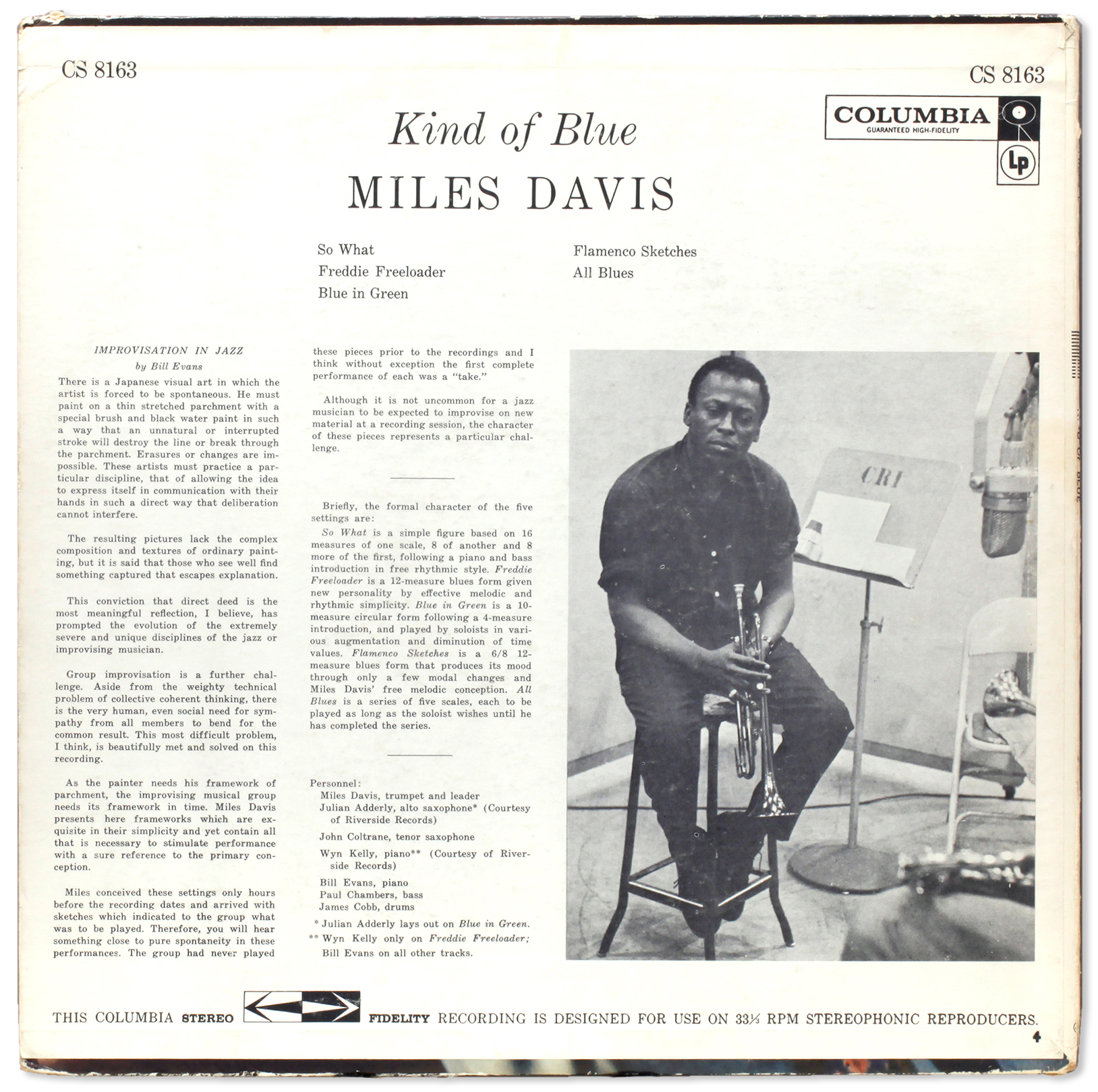
Track selection: All Blues, or maybe Flamenco Sketches, it’s the long first track on Side 2. I read somewhere the order is different from what the cover says.
Artists:
Miles Davis (tp) Cannonball Adderley (as) John Coltrane (ts) Wynton Kelly or Bill Evans (p) Paul Chambers (b) Jimmy Cobb (d) Columbia 30th Street Studios, NYC, March 2 and April 6, 1959
Music/ Vinyl
Yes I know I have posted this one before but this is the Six-Eye. I am not worthy. Well I am, but not to boast…it has been a long wait and I can now move on. The Six Eye has landed
Kind of Blue Citations
On October 7, 2008, Kind of Blue was certified quadruple platinum – four million in sales over fifty-odd years. So not rare then, though how many of these were the original Six Eye remains unknown. Compared with genre-defining Britney Spear’s single Baby One More Time, ten million in sales, four million is remarkable for a jazz album. What happened, America? A sudden outbreak of good taste?
Kind of Blue is included in the book 1001 Albums You Must Hear Before You Die, described by reviewer Seth Jacobson as “a genre-defining moment in twentieth-century music, period.”.
It is ranked number 11 in the Rolling Stone List of the 500 best albums of all time.
On December 16, 2009, the United States House of Representatives passed a resolution honoring the fiftieth anniversary of Kind of Blue and “reaffirming jazz as a national treasure”. So they can get some things right after all.

(updated 27/2/13) Any one clued up on the Columbia matrix code numbering system can tell you the above copies derive from the 1st tape or mix of Kind of Blue, the 19th lacquer cut for side 1, and 26th lacquer cut for side 2. The master tape generated a large number of lacquers, one assumes of “identical” quality being from the same tape and cutting lathe. Each lacquer in turn generated perhaps 10 mothers, and each mother perhaps 10 stampers – the numbers vary in differing accounts of the process. The mother or stamper number is sometimes seen faintly in the runout. Each stamper was good for pressing perhaps 2,000 or more discs, and this was the main point at which the quality of the pressing is determined – each repetition of the press applied 100 tons of pressure from the stamper to the hot vinyl biscuit, progressively deforming the grooves of the stamper. First off the stamper = nirvana, last off…worse. No way of knowing except listening.
Collector’s Corner, at the Kind of Blue Cafe
And how would sir like his Kind of Blue: – Rare?
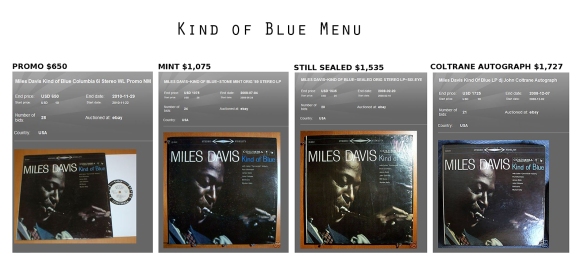
Rare? I like mine medium rare, thanks, no, make that just medium, is there less than medium, not at all rare, just as it comes…ordinary, any which way … Does it come with fries?
The other week I walked into a record store in West London which I rarely visit nowadays, after a copy of Blakey’s Roots and Herbs on Blue-black Liberty/UA they had listed online. Nice pressings, sought after by jazz-loving cheapskates.
After a long chat and catching up, bragging about the success of the blog, swapping URLs, and settling the tab for the Blakey, I was half out the door when Laurence, the owner, called me back. Might I have an interest in a copy of Kind of Blue that had just come in?
I laughed.
Kind of Blue? Thanks but I’ve already got the original UK Fontana and the CBS , I said.
Well, this is the American original six eye, just come in, he said, disappearing into the stock room and fishing it out of a shipping box. Jeez you could have knocked me over with… anything that came to hand. A truck? THE Six Eye! Stereo!!
Fairly nice condition, a few superficial scuffs, definitely VG plus, maybe plus plus. Nice cover too.
Hmm, I could be interested, I said, faking cool. The outside says maybe, the inside says (jumps over the counter, hands clutched around throat, eyes bulging, Give it to me! Its mine! I deserve it, I want it , I want it NOW!)
Depends. How much were you thinking of? He disappeared into the backroom to check Popsike.
I hate this moment. After what seemed an age he returned. And threw a figure into the air, a fishing trip, to see if I blinked. Instead, I swallowed…
That seems a.. a.. a fair price, yes, umm.. I can live with that. We agreed a very fair price and I took it home, more excited than in a long time.
 After dinner I retired to the listening room, with a bottle of Cote du Rhone and the Six Eye. Powering up the Avid, I mounted the Six Eye on the turntable (eat your hearts out playlist peckers), lowered the arm, and sank back into the sofa as the needle bit the vinyl. Moment of truth.
A few clicks you often find where the needle drops, and then…
Wow. It is sublime. It lives. It breathes. I have never heard Kind of Blue sound like this, a whole different record. Amazing. It was not like listening to a record, it was like being present during the performance in the presence of greatness. Bill Evans, John Coltrane, Cannonball Adderley, Miles Davis, all playing in my humble living room. This is what it is all about. Brings tears to your eyes.
Every word they say about it is true about the original, to my ears any way. The vinyl is not perfect,a few clicks, but who can pay the price of perfect?
Waiter, is service included? This bill looks rather too small.
 LondonJazzCollector

“All Blues” is a blues composition. “Flamenco Sketches” has an unmistakable Spanish tinge. Whenever Miles played “All Blues”, he never called it otherwise. Enough said.
LikeLike
The article does bring up some good points though and to my ear, “All Blues” with the piano figure in the beginning, sounds way more flamenco inspired than “Flamenco Sketches” which is quite slow and pensive. Although it is just pedantic at this point, it was fun listening to these masterworks again and imagining what title is more fitting.
LikeLike
In 2012 Jeremy Yudkin, Professor of Music at Boston University, published a thoroughly researched, and thoroughly intriguing, article on this.
As you can see from your images, the first pressing had the Side 2 titles in different order on the label and the back cover. Two months after the LP was released, Miles’s new producer Teo Macero ordered future pressings to use the order given on the label: 1) All Blues 2) Flamenco Sketches. This has been used ever since.
But Yudkin argues quite convincingly, based on both musical and historical evidence, that the correct titles were the ones on the cover: 1) Flamenco Sketches 2) All Blues. Not only does this reflect the descriptions of the tracks in Bill Evans’s notes, but the handwritten manuscript of the notes survives to prove that Evans had the titles this way around. Making your sample track above into Flamenco Sketches, although nearly everyone knows it and refers to it as All Blues.
LikeLike
Interesting, and quite possibly true that the Side 2 song titles were incorrectly reversed, however we have a different purpose from Professor Yudkin. The significance of the sequence change for record collectors is not in naming the tunes correctly, but because the sequence change unambiguously identifies records from the first pressing.
The label “correction” is believed to have taken place around November 1959, on the instruction of Teo Macero (according to Enrico Merlin, author of the new book Miles Davis 1959, A Day By Day Chronology). The presence of the Side 2 original sequence is proof of “early pressing” status 8/59 to 11/59. Beyond that, the point is moot.
LikeLike
(continued from below)
Thanks Dottore, and apologies for robbing you of your time. Your observation would coincide with most of the (scarce and unreliable) info I have gained from the Internet, i.e. original mono & stereo editions would show the same speed anomaly. In other words, if there ever was a separate full-track recording – which some people allege to have existed – it was not used in the mastering of the original mono LP. Purported “artists’ intention” aside, I prefer to listen to KoB in the shape of the speed corrected stereo version.
LikeLike
mmh, why not two different equipments, mono and stereo with the same speed intentionally anomaly, two different masters with wrong speed, two masters approved by Miles and/or Teo?
science fantasy?
LikeLike
For my money – yes. Why would someone want to do that? To an average listener, a two-point-something percent difference doesn’t change the pace and character of the music enough to be of any aesthetic relevance. And talking about the educated listener: We don’t know whether Miles and/or Teo were blessed with perfect pitch – you either have it or don’t have it, no matter whether you are a musician or not. (It’s a mixed blessing, I’m told.) – My guess is that it was a technical issue considered too insignificant for anyone to bother about. After all, NOBODY KNEW that KoB was to become one of the iconic works of 20th century music.
LikeLike
BTW, they didn’t even care to spell Julian Adderley’s name correctly on the record cover.
LikeLike
While someone’s already mentioned Teo Macero’s assertion that he and Miles added the speed increase deliberately, the most likely explanation I’ve heard is that the session tapes for the March 2nd session (which comprises the track on side one) are all fast because the tape machine was running slightly slow that day and no one noticed until after the fact.
Since the Mono and Stereo mixes were both made from these tapes, the side one tracks have the speed issue while the ones from the later April 22nd session do not.
LikeLike
Absolutely convincing.
LikeLike
Guys: Columbia always recorded at this time with two teams: one for full-track (mono) and one for three-track (stereo), and they ran two machines for each team, one master and one backup:
“According to Mark Wilder, Columbia’s practice at its 30th Street studios in 1959 was to use four tape decks simultaneously: a prime mono deck and a mono backup, for mono LP release; and a prime three-channel deck and a three-channel backup, for stereo LP release. The mono tapes have since disappeared. The backup three-channel tapes (the ones we heard) were sent to the vault, where they rested untouched from 1959 until 1992.”
(http://www.stereophile.com/thefifthelement/206fifth/)
There’s an old thread at the Steve Hoffman forum where a couple members attempt to prove that the original mono LP has a speed variation as well but what they come up with is about 14% of a half step for the mono, while they don’t even check to see how much faster the original stereo LP is. I can only imagine it’s significantly faster than the mono (I’ve personally heard the difference between an original stereo LP and the stereo Legacy remaster), and that the pitch variation on the original mono LP that the Hoffman members found is merely due to the most subtle inconsistencies in the tape machines used for the recording and mastering of the original mono LP.
By the way, I’m with Felix in that I personally don’t buy Macero’s story that they sped up the stereo tape on purpose.
LikeLike
I have not previously heard of Columbia running four tape machines at once as stated by Mark Wilder in the Stereophile piece. Of course, anything is possible and now that the Fred Plauts and Bob Wallers of the world have moved on, I’m not sure anybody has firsthand knowledge at this point. I have read in multiple sources that up until the mid-1960s, Columbia’s 30th Street Studio ran two Ampex 300-3 (three track) machines, one primary and one safety. Ashley Kahn’s recent booko n “Kind of Blue” states there were two three track machines and I recently read the same information in Andrew Kazdin’s account of his work at Columbia with Glenn Gould.
This was fairly widespread practice at those studios that could afford it. Bob Fine at Mercury also ran two three track Ampex 300-3 machines for the Living Presence series, at least until he acquired Harry Belock’s 35mm magnetic film machines (although now that I think about it, Fine also ran a dedicated mono setup while Mercury still issued Living Presence titles in mono).
Since Columbia created both stereo and mono master tapes from the three track session tapes* (at least for pop music sessions like “Kind of Blue”), I’m not sure why they would have run additional mono recorders during the session unless they were, say, 7 1/2 ips reference tapes for the producers and musicians to take home and evaluate. This of course would explain why there are no mono session tapes: they simply never existed.
With regards to the speed difference: I’ve digitally corrected the speed on transfers of the LP more than a few times and slowing side A down 1.5% (-0.26 semitones) will get you pretty damn close to A = 440Hz. Again, since the session tapes are the source of the speed change, the original mono and stereo LPs both run at identical speeds (I just compared them just to be positive).
I was going to compare the exact running times of “So What” on both LPs just to be precise, but to my surprise, I found out that even though the pitches are the same, the mono version is a few seconds longer. The reason for this is that while the fadeout on the stereo LP runs about 10 seconds after the last horn notes, the mono LP continues on for a full 24 seconds. Even more interesting: Jimmy Cobb’s drums fade out sharply about 5 seconds after the horns on the stereo LP leaving the last notes heard from Chambers and Evans alone. On the mono version, the drums continue the full 24 seconds, with no separate fadeout, which proves the mono and stereo LPs are different mixes made from the same (slow) session tapes.
*This is per W.B., who for my money seems to know more about what actually went on at Columbia back then than anyone else I’ve ever heard from so far: https://londonjazzcollector.wordpress.com/2012/12/08/taking-liberties-the-poor-mans-blue-note/#comment-5390
LikeLike
The fadeout is not the same length on all stereo releases. But as you say, speeds are identical. Felix, did you adjust the speed by just listening and comparing pitches by ear, or did you look at the wave diagrams and calculate speed differences? I don’t remember precisely, but I think the difference should be more than just 1.5 %. I’ll try and check again soon.
In comparison, the 14% of a half step quoted by Rich would be negligible, it would amount to just 0.84% of the speed in absolute terms, which is well within the margin allowed by the old DIN standard. But I still don’t believe those Steve Hoffman forum guys who claim that there is a difference between the mono and stereo versions. There isn’t.
LikeLike
It’s splitting hairs really, but I found the difference to be 1,97%, i.e. very close to 2%.
However, I don’t own the Columbia Six-Eye. My point of reference was an early ‘sixties UK pressing of CBS SPBG 62066, and I compared it with the pitch-corrected Legacy CD.
I compared the wave diagrams. You could’t do that with a tuning fork.
LikeLike
Eduard, FTR, the Hoffman members were claiming that side 1 of the original mono and stereo LPs were both fast, and while they “proved” that the mono LP runs about 14% of a half-step faster than the stereo Legacy remaster, they never tested the original stereo LP (shrug). Here it is in all its unscientific glory lol:
http://forums.stevehoffman.tv/threads/miles-davis-kind-of-blue-mono-speed-issues.232772/
LikeLike
Had they tested the stereo LP with the same “method” they were applying to the mono, they might just as well have arrived at their unscientific “14% of a half-step”, I’m sure.
LikeLike
We certainly do butt heads on here quite a bit, don’t we? 😉
Although that post might suggest that only one type of tape machine (three-track) was used because it simply claims that two separate mixes were made for sessions, it doesn’t explicitly state that the mono mix was made from the three-track tape. I will admit that it’s tempting to think that there never were full-track masters because they don’t exist for Kind of Blue, but Steve Hoffman has had something to say about Columbia’s practices in the past:
http://forums.stevehoffman.tv/threads/question-about-old-jazz-records-mono-vs-stereo.38791/#post-718422
Also here:
http://forums.stevehoffman.tv/threads/question-for-steve-et-al-regarding-columbia-mono-vs-stereo-mixes.52449/#post-1051945
This video (from 1959 apparently) seems revealing as well:
At about 3:50, the engineer seems to be starting three decks. Then at 5:25, a dead-on shot of what I imagine is a full-track Ampex. Then at 6:45, it appears that they choose to use the full-track deck for playback of the recording for Gould. Perhaps it’s just a “backup reel”, but it’s interesting that they used it for monitoring. It seems like there is only three decks running, but who knows, maybe the mono safety reel was running non-stop somewhere else or out of the camera shots…? It does also look like there’s an unused tape machine to the left of the three track machines…?
But there’s also all the press about how the Bob Dylan and Miles Davis mono box sets were sourced from mono master tapes with a handful of exceptions, and though I suppose one could argue that the mono masters were mixed down from the three-track, both Wilder and Hoffman’s testimony leads me to believe that Columbia did record straight to full-track and three-track simultaneously through the early sixties.
LikeLike
Thanks for posting that great video! I have never seen that before. What an amazing window into Columbia’s 30th Street studio (and its control room, no less).
Fred Plaut, engineer/photographer extraordinaire (who also worked both sessions of Kind of Blue as well as doing the session photos for the second session) can be seen adjusting the microphone at about 3:43. The producer for the session is Howard H. Scott:
I agree with you that they are clearly running three Ampex machines at once in the control room: two 300-3s and another single track recorder, as you pointed out. As you note, this doesn’t tell us what the purpose of the third, single track recorder is. Based on the way it is shown being used in the video, it seems to me like it is there for playback and monitoring.
I can see in the two links that Hoffman is asserting that the mono master tape was made live on the spot (he also seems to imply that the 3 track tape was ‘mixed’ live as well, although it’s not clear to me what he means by that).
Here’s what Ashley Kahn’s book says regarding the topic:
“A total of seven microphones were used, mixed through the control room board to down to the then state-of-the-art three tracks. In 1959, with the phenomenon of stereo only beginning to establish itself among music consumers, the three-track master would then be used for both stereo and monaural versions of the album”.
-“Kind of Blue, the Making of Miles Davis’ Masterpiece,” pp 101.
Kahn’s source for the book regarding Columbia’s practices in that era was Columbia engineer Frank Laico, who worked at the 30th Street studio from 1949 up until its demise in 1982:
http://www.legacy.com/obituaries/seattletimes/obituary.aspx?pid=164421572
Perhaps most significantly of all, if we know the three track session tapes run fast (this is also confirmed in Kahn’s book) and the original mono LP cut from the mono master tape also runs fast, it follows that the mono master tape had to have been created from the same problem tape recorder and not from a separate, dedicated mono recorder.
If the mono LP was created from a dedicated mono recorder (such as the one in the video), you would expect it to run at the correct speed, just as we know that the second ‘safety’ Ampex 300-3 did and the resulting LP speed would not be fast.
None of this precludes the existence of mono master tapes for Columbia releases (like Bob Dylan’s LPs), which there undoubtably were (obviously the original mono master tape for Kind of Blue no longer exists. It was probably worn out and then discarded at the close of the mono LP era). It merely confirms W.B.’s original correction of my mistaken assertion that Columbia mono LPs were simple ‘fold downs’.
Given the ongoing discussion of the speed difference, it’s nature and its origin, I finally resolved to establish the facts once and for all with measurement rather than continued subjectivity. In case it wasn’t clear in my original post, I have been comparing only original Columbia Six-Eye pressings, both mono and stereo, whose master sequence begin with ‘1’ indicating they were cut from the original master tape.
To do this, I used the opening note of Miles’ solo on “So What”. The solo starts on the tonic, that is, D natural. Specifically a D5. The correct frequency for a D5 using A = 440Hz tuning is 587.33 Hz. I excerpted this single note from both the mono (CL 1355) and stereo (CS 8163) LPs.
Using Audacity’s frequency analysis feature we can clearly see the harmonic distribution of Miles’ first note:
CL 1355:
http://postimg.org/image/6lhzddwaj/
CS 8163:
http://postimg.org/image/3wqhpqt1r/
Using the peak locater feature of Audacity’s spectrum analysis tool, we can find the precise frequency of the fundamental (the first hump indicated by the arrow). The results for both a circled at the bottom.
D5 measured on CL 1355:
602Hz
D5 measured on CS 8163:
600Hz
So first off, we can see that the difference between the mono and stereo is only 0.3%. This translates to a value of 0.05 semitones or 5 cents which is generally considered beyond the tolerance of human perception.
This discrepancy could be due to any number of factors such as cumulative speed differences between the various tape machines used to edit and play back the tape used to make the LP. In this case, it might also be explained by the fact the mono transcription was done on a belt drive turntable while the stereo was done on a quartz sync direct drive. For this reason, I’m going to make the assumption that the stereo pitch is the more accurate of the two.
So what is the speed difference between a true D5 and the D5 heard on the LP?
600 Hz divided by 587.33 Hz tells us:
The LP is exactly 2.16% above correct pitch (37 cents sharp).
These results should be easily reproducible.
LikeLike
Thanks for taking part Felix, I admire your attention to detail. 🙂 Isn’t that video amazing? The history of studio recording is just fascinating.
Thanks for shedding light on what’s in the Kahn book, I’ve read it but I don’t own it, and I guess I missed that detail. Knowing that Kahn’s source was an engineer who was employed by the studio during the making of Kind of Blue is pretty solid evidence. Does that mean that Wilder and Hoffman are mistaken in their assertions? Perhaps they are.
What’s happening in the Gould video seems to confirm Kahn’s assertion. Regarding the three machines in the video, maybe they used a full-track machine just for monitoring, as a reference tape as you suggested, so the master three-track tape would remain 100% free from wear caused by repeated playback during the recording session…? (Van Gelder apparently did this too, as indicated in the Love Supreme book.)
I agree that this all doesn’t imply that there weren’t mono master tapes for Columbia recordings, but it does seem to suggest that these mono master tapes were derived from the three-track tapes. This means that the mono masters are technically second-generation. I know from experience that the accumulation of additional noise that arises from tape duplication can be significantly minimized with high-quality equipment, but it’s interesting to think that someone like Van Gelder went to great lengths to assure that this didn’t happen with his 50/50 system (AFAIK, Tom Dowd did mix-downs with Atlantic).
Because the mono master is fast also, I guess this supports the claim that it came from the three-track tape, though it would be a much more compelling piece of evidence if both the original mono and stereo LPs played back at the same speed. I certainly can’t hear a difference between the two…maybe a 0.5% variation (which I found using a quartz-lock, direct drive 1200 for both the mono and stereo LPs) is considered within the acceptable range of speed variation for these professional Ampex machines…? It’s also funny to think that Wilder must have thought he was attempting to mimick a live-to-full-track session tape when he was mixing the three-track for the new mono digital remaster, when in reality he may very well have been doing the exact same thing the Columbia engineers did back in the day!
As for the W.B. and Hoffman’s respective claims regarding post-mixing, I suppose it’s possible that there was no tampering of the relative balance, EQ etc. of the tracks on the three-track tape between recording and mastering, and that the mono master was ultimately a mix-down and not a fold at the same time.
In the midst of all this uncertainty, it’s assuring that one way or another, these great recordings got into our hands for us to listen to and enjoy!
LikeLike
Felix, when you came up with that -25% difference in pitch, was it for the original stereo LP or the mono (I’m assuming you meant stereo)?
LikeLike
But Felix never spoke of a -25% difference in pitch, did he?
LikeLike
Oops, I see what you mean, Rich. Felix had 1,5% against our 2%.
LikeLike
Last thing (I think): at the very least, the nonexistence of the KOB mono master tapes does not suggest much to me about Columbia’s recording practices because it seems pretty clear that mono master tapes do exist for other albums from that time (Miles, Dylan, etc.). Now whether or not those tapes were mixed down from the three-track or not is another story. End of the day, it’s all just fun and games. I like my original mono LP and I also like my stereo digital remaster. 🙂
LikeLike
Now don’t say I never did anything for you guys: 😉
Since I have original mono and stereo LPs of Kind of Blue (neither in NM condition, sadly) and the Legacy CD, I put together an audio clip comparing “Freddie Freeloader”. First is the original mono LP, second is the original stereo LP, and third is the Legacy digital remaster. Then at the end I put a little blip in that quickly shuffles between the first chord of “Freeloader” for all three versions:
http://www.divshare.com/download/26325112-25b
Regarding what I hear, the mono and stereo indeed do sound very similar, and I can hear the pitch drop with the Legacy version.
Mathematically, I compared the lengths of the first measure of “Freeloader” for each version. If We take the Legacy version to be the absolute, the mono LP is about -1.64% time-wise (shorter in length i.e. faster), while the stereo is -2.17%. I’m sure I could get a more accurate reading if I extended the sample length but I think I’ve done enough!
So what do you folks hear?
LikeLike
Your findings about the stereo version do not differ greatly from mine, do they? Taking a longer sample might provide a better result. I went from the beginning of the song to the beginning of Miles’ solo, (2:10,47 and 2:13,05, respectively).
But there IS a speed difference between mono and stereo, it seems. Hard to detect by mere listening, because the mono/stereo difference is just half a percent according to your findings.
LikeLike
Something to think about is what the heck was going on where there was all these speed variations between machines? I mean, I can imagine that at a certain decimal place no two tape recorders will run at identical speeds, but are these variations typical of tape recorders at that time? It would be interesting to take a Van Gelder Blue Note album from the era where he recorded to both full-track and two-track and see how subtle the differences in speed are. And maybe doing the same for Brubeck or Monk on Columbia…pretty sure Coltrane on Atlantic was eight-track only mixed down separate to mono and stereo masters…did Roy DuNann record to both full- and two-track tape? I think he did…
Anyway, it’s all very interesting (that Glenn Gould video is especially amazing), but it doesn’t do anything to make me prefer one version more than the others–we’re obviously excelling at our usual task of nitpicking here! 😉
LikeLike
currently listening to a very nice 6-eyes mono copy. it’s been here for a while and a reference, compared to later pressings – or cds… as a 6-eyes stereo is finally on the way (thanks andrew for your help) i’ll have soon the pleasure to compare both 😉
LikeLike
interesting article here:
http://www.analogplanet.com/content/miles-davis-kind-blue-monophonic-reissue-sonylegacy-analog-planet-exclusive
LikeLike
Fascinating. Compelling argument that every jazz fan should source both mono and stereo editions, so they can join in the debate.
LikeLike
currently on ebay, there’s an interesting sale of a test pressing by bernie grundman of the alternative take of “flamenco sketches” in 33/45 rpm
def collector’s item 😉
LikeLike
Quoting from your link:
“Back in 1992 Wilder discovered the KOB speed anomaly that resulted in side one of the original album being slightly sharp in pitch because the 3 track recorder was running slightly slow during the recording session. Of course this did not affect the mono version, which was sourced from a different recorder, but for this mono reissue, the speed had to again be corrected.”
So the speed anomaly “did not affect the mono version”? What mono version? The original mono LP? From what I am told by Dottorjazz and other sources (see post above), the original mono LP is the same speed as the original stereo version.
The original mono tape (if ever there was one) was stolen, repurposed, degaussed, whatever. But it was not used in the mastering of the original mono LP.
LikeLike
the six-eyes has landed… i repeat: the six-eyes has landed…
8th step to heaven? let’s hear it.
i bought this copy on discogs, graded VG+/VG cover. i asked the seller for hi-res pics and believe me, i have seen much worse VG+ advertised covers… matrix numbers 1AG/side1 – 1/AJ/side2 looked promising, as the overall looks of the wax. no marks or hairlines apparent at all, but i know flashlights and sheer optimism can be delusional. i finally took my chances as price, including shipping – was lower than any and worse VG+ auctioned on ebay for weeks. i assumed i could cut my losses if i didn’t like it.
now it’s here and it looks gorgeous. i first notice the kind of blue is different, less cyan and more magenta. same for the pic where miles’ skin looks redder. the pic is cropped differently, closer on his face and at shoulder level to leave some space above him for the groovy stereo fidelity graphics. back cover looks great with a painful $3.89 ballpen handwriting next to the title 😉
xcept for being quite dirty – it actually may have protected the grooves 😉 wax looks exceptionally nice for a 55 years-old Lp… i had fear that the “so what” intro would be noisy – hell, even some cds are – but it plays beautifully. freddie F sounds great, trane’s solo intro blastin’ in with full force. as andrew noticed, sound “seems” much fuller /spacier than mono version but i’ll compare later. Blue in green: xcept for very low background noise, music prevails though evans outro suffers near deadwax but i guess some deeper cleaning can make the best out of it.
same pleasant surprise with side2/ no disturbing background noise, even at higher volume. it is a very nice and satisfying pick as whether stereo or mono, this session is pure magic and i’ve been listening to it at least once a week for 40 years. besides the magic, this purchase is a nice investment in a piece of jazz history and the Lp covers are genuine small art objects to me.
of course, i couldn’t resist to put the mono version back to back and… at my great surprise i tend to prefer the mono version, which i find more engaging and “there” than the stereo… gulp! and i’m not even using a mono cartridge or arm tone… just the mono switch of the preamp! both copies are of similar grading so there’s no unfairness here… for instance, i’m hearing more of the famous CBS studio “sound” on the mono copy, something that is very specific to this session and very dear to my ears…
this said, i need to listen to them on different speakers to have a definitive feedback. here were plugged thru Quad II monoblocks a pair of Goodmans 612C triaxiom +ARU in DIY enclosures that i found recently instead of my trusty 1960 Tannoy Canterbury corners (red monitors 12″s). TT is Technics sp10mkII with Thomas Schick 12″ armtone and DL103R cart (in Uwe panzerholz body and headshell), preamp Sony TN86B+Mogami + Belden/Shindo cables.
more to come…
LikeLike
Ever hear what Miles or Teo did with a track called Go Ahead John off Big Fun was one of the worse listening experiences. They took the whole track and keep hitting a button on the board during the mix. So it has this horrible clicking panning effect. Fortunately it was fixed on the Jack Johnson box set.
LikeLike
some heresy here: i really like the alternate take of “flamenco sketches” issued on the evil-silver “miles Davis Kind Of Blue 50th Anniversary”. anyone knows if it appears on recent vinyl reissue?
LikeLike
I haven’t been lucky enough to find an original Kind of Blue. I mean, Good Luck trying to find one. I currently have three pressing from Classic Records, 180Gr, 200Gr, and a extremely Rare 200G clarity Vinyl.
LikeLike
Do you have a preference or notice any appreciable difference between the three?
LikeLike
Oh yes, the clarity pressing is dead silent and errie. Really beautiful.
LikeLike
Just had some time to compare my original NM stereo 6-eye with my original NM mono 6-eye. I have had the mono for a while now and always thought it lacked a bit of complexity. It seemed on the simpler style even though it had a nice gritty style. It wasn’t punchy like many monos can be which surprised me, but that could have just been the the lower half of the stamper. Upon hearing the stereo I could see what I was missing. The sound just opens up in terms of breadth and clarity. The mono is just flatter compared to the stereo.
What impressed me most about the stereo was that it really had that extra level of excitement. You don’t just hear Miles, Cannonball and John playing their horns, you hear the space between each note and their breath as they blow each note. Something only the finer sounding albums do on vinyl. The drums had that extra snap to the snare drum that hangs there in mid-air. And the music just dances in front of you.
Well worth the wait and for those of you that don’t have this yet, I can’t recommend it enough. It can still be had for a good price with some digging around.
LikeLike
Thanks for sharing the experience – at least I know I am not crazy. That or both of us are.
Postman just delivered this morning – not a royal baby, but a stereo copy of Coltrane’s Africa Brass, to complement my mono copy. If it works with Columbia lefts see how it works with Impulse. RVG STEREO stamp in the matrix, original AM-PAR gatefold cover, but a US 60’s later press on black with red ring N.Y 10019 address. I’ve rated these the equivalent of Division of Liberty. Nothing quite like testing your own advice with your own money eh?
If its not good I’ll have to take myself to task…
LikeLike
Hi David,
I fully understand your enthusiasm, and who wouldn’t? You can add to your experience by slowing down your turntable by 2 percent when listening to the tracks on Side A (So What, Freddie Freeloader, Blue In Green) to get the original pitch. The mistake was not corrected until 1997. Resorting to the Columbia Legacy CD (anathema to vinyl lovers, I know – but still my favourite “Kind Of Blue“) you will get all that extra level of excitement without having to tamper with the speed. To my knowledge, there has never been any “pitch corrected“ vinyl version.
Eduard
LikeLike
I do recall that pitch difference, but I think messing with the turntable speed is above my pay grade! It’s never bothered me so I wouldn’t want to take the risk of mucking up the system. Plus, it seemed good enough for Miles since it wasn’t fixed immediately. I do have a nice K2 SACD if need be, but it will be hard to stay away from the stereo LP!
LJC – curious about your findings on the Coltrane!
LikeLike
Was it good enough for Miles? We’ll never know, and perhaps he just didn’t care. I can imagine his four-letter word reply when he was told about the issue. Anyone who tried to play along with the record was aware of the fact, and heaven knows why it took so long for Columbia to solve a problem that is so easily solved.
LikeLike
Eduard,
The Classic Records vinyl is pitch corrected. Here is an interesting quote from Teo Macero who produced Kind Of Blue regarding the speed issue:
“And then we had a lot of special equipment that I had CBS invent for me. I would say, “Look it, I have a crazy idea in my head. I want to be able to change the pitch, change the speed.” They said, “Teo, we can’t do that. We hear they’re working on that in Europe.” And I said, “But I want to move that beat, just off, so that if we slow it down just a little bit it will put it into the right, as the guys now say, pocket. That was a lot of favorite expressions of these guys, put it in the pocket. So, what I would do, I would put some tape around the cap stand and slow it down just enough to give it a better groove…Now, I did this so frequently with Miles that it was like second nature for me because I didn’t have to worry about anything because I knew that there was one record that we did with, Kind of Blue. You’re all familiar with that. Well, that record came out and was a huge success. Much later, maybe about ten years later somebody said, one of the trumpet players who happened to come to the studio said, “I can’t play with this thing because it’s just off pitch.” “Aw,” I said, “Really?” Laughs.
They made such a big issue out of it, I said, “Look it, what they hell do I care? I couldn’t care less!” I said, “If Gil Evans, who is the daddy of them all. And Miles, who made it, and a few of the musicians and myself, we like it. Then it must be right.” He said, “But you know, the tape is regular speed.” I said, “Look it, I have no control about that.” They said, “Well we’re going to change it.” And they changed it.”
LikeLike
Thanks Aaron, I wasn’t aware of the Classic Records KoB. I hadn’t read the Teo Macero interview either – very interesting stuff, shedding some light on this issue, and on studio work in those days in general.
LikeLike
Yes thank you Aaron. I’d always suspected that it was deliberate, but had never seen any interviews that confirmed it. It seemed inconceivable that Miles or Teo wouldn’t have spotted it, and it would have been just as easy to change as the song title screw up on side two.
Speeding up the master tape was fairly common with pop records of the time, so it always seemed the likely reason.
I for one think it is a shame that the releases are now the corrected version rather than the one that the producers of the record desired.
LikeLike
Hi Dean,
I think all the interview confirms is that Teo Macero didn’t care about the mistake that had been made – but it does not confirm that there was anything “deliberate“ about it from the start. It is true to say that Teo used all kind of trickery in later years to get the results he wanted (which is perfectly OK!), but at this early stage the simple truth was that no one noticed the mistake until the record was out. So it’s perfectly all right to listen to KoB just the way it was played in the studio, and to do so without any regrets about possibly violating the artist’s intention.
LikeLike
To (hopefully) wrap this up, I would like to ask owners of the original MONO Kind Of Blue a very, very simple question. It seems simple enough to me, anyway:
Does, or doesn’t, the original MONO vinyl version show the same speed problem as the stereo version?
If it does, then the mono was just a plain fold-down of the three-track tape, and any myths about a separate tape machine that was run for the mono version must once and forever be discarded.
If it doesn’t, then a separate tape recorder was used, and any esoteric speculations about the politically correct speed (“If it was good enough for Miles, then it’s OK etc.”) are off the point.
Unfortunately, I don’t own the original mono, or else I would have checked its speed a long time ago.
LikeLike
a couple of hours of exhausting listening drove me mad.
it seems to me, but I can’t swear, that Mono six eyes is exactly the same speed than Stereo.
I don’t have six eyes stereo but I have the Classic Record 1995 stereo edition in two LP’s.
on the first we have the Original speed and on the second the Corrected speed.
for me Mono and Stereo are the same speed while corrected tracks are all slower, just a little bit.
is it possible that BOTH mono and stereo equipment were calibrated the same way?
LikeLike
Thanks, Dottore… (continued above!)
LikeLike
This site is DEEP! Always finding amazing old posts on here…what a great story!
And yes, from what I understand the time in the life of the stamper that a copy was pressed is the number one differentiator in the fidelity of various vintage pressings of a particular title.
LikeLike
Reblogged this on pinknoyze and commented:
The light hasn’t been nice for photos lately, so I’m posting this raving vinyl maniac’s recent find, which I think is quite lovely.
Diana
LikeLike
Does this mean LJC may be going viral? How exciting.
For a “crazy”, I confess I do consider myself “borderline”. On the wrong side.
LikeLike
I love your kind of crazy, LJC ♪
LikeLike
If I ever get to London…. I want to hear that in your listening room. I never heard the whole album until sometime in ’05. Stopped me in my tracks at work (hunched over trays in the darkroom), said to self “I know Bill Evans when I hear him !!!” (Cause I grew up under my father’s baby grand, listening to Bill). And I certainly know how amazing vinyl can be. Congratulations on your purchase, and maintain your cool in the store. 🙂
Diana
LikeLike
Hello Lucky Jazzcollector. Just read your story ’bout Miles’ album…. “I am just a jealous guy” sang John Lennon. And he’s right! I got this album in three different vinyl-versions and several cd-outfits. But NOT thé original, you got now. Congratulations! I wish I was in London @ the right place and right time. This album is for my jazzanthem and the start for a wonderfull jazzlife. When I heard ‘So What” for the first time I was “turned around”. Since then (1990) I’m collecting every vinyl of him and a huge Miles fan. Even called my jazzradioshow So What! I’ll keep reading your albumstories: they are firstclass! jazzy greetz from Dordrecht, Holland Ben Korzelius http://www.atosrtv.nl ________________________________
LikeLike
I just laughed out loud when I read, quote: “jumps over the counter, hands clutched around throat, eyes bulging…” My Monday morning blues immediately faded away. Congrats, LJC, a superb find. Maybe the next challenge would be to secure a mono copy of this gem 😉
Quincy Jones once said: “It will always be my music, man. I play Kind of Blue every day – it’s my orange juice. It still sounds like it was made yesterday.”
I know we’ve seen some hot fired debates here lately about whether ‘certain details’ can or cannot confirm a 1st pressing, etc. but still: any comments on the stamped numbers in the trail off to confirm, well, ehrrr… its ‘firstness’?
LikeLike
(Spelling corrected Matty, all part of the service)
With so many copies sold, this is one candidate for remastering, and I wouldnt be suprised if there is a smart alec somewhere with a Phd in KOB, just bursting to let me know mine is an Indiana plant fifth remaster from mother 9 stamper 9, pretty well bottom of the pecking order… dont know why I bothered.
You know I am a mono-by-preference guy but the stereo here lends it a kind of presence in the room that feels quite natural.
LikeLike
Not to be the aforementioned smart alec, but:
Looks like ‘1AJ’ for side 1 and ‘1BD’ for side 2.
As far as I understand the Columbia system, the ‘1’ indicates the number is the master number and the letters the mother sequence, so this is a first pressing (depending on your definition).
As for the mother sequence, I believe the letters translate to digits. A=1, B=2, etc. I don’t recall ever having seen letters after ‘J’ in a Columbia matrix so that seems pretty plausible. If that is correct, then your pressing would have been made from the 19th mother for side 1 and the 24th mother for side 2.
I also believe that you can determine which Columbia pressing plant (as well as stamper info) by whether there is a single letter used to indicate stamper sequence or tally marks (I can’t make out either on your photos).
I have both a six-eye and two-eye stereo pressing. I can check the runout info and report back if anyone is curious.
LikeLike
Not so much Smart Alec as Smart Felix. Different thing entirely. Good boy.
More information is good. Fetch, boy, fetch!
What defeats me is the number of mothers – 19 and 24th?
This is a quote from a (paper) article from 2010
“the single metal master copy of the original lacquer could safely produce three or four positive mother copies, and each should produce five negative stampers before quality starts to fall of….around 3,000 LPs could be pressed from each stamper for a normal commercial release. ……Teldec engineers eventually learned to pull between 30-40 high quality stampers from each mother.”
(Secrets from the Groove, making vinyl in the 1970’s)
Barry Fox, HiFi News July 2010
Elsewhere I have read of a maximum 8 or 9 mothers from one master. I know nothing ,but 24 seems a big number for 1959 technology but perhaps its true.
LikeLike
I did a fair amount of listening, examining and note taking last night.
Here’s the goods:
6-eye:
Side 1 – 1A (1 score mark)
Side 2 – 1AE (2 score marks)
Side one also label has a very tiny (maybe 3.5mm), faint ‘JM’ embossed into the label. Very weird. I’ve seen similar marks on other 6-eye stereo labels as well (yours doesn’t seem to have this).
2-eye:
Side 1 – 1CD (also dotted inverted ‘V’ and ‘3’)
Side 2 – 1CH
Side one features a very faint sideways oval before the ‘XSM’ in the matrix. Side two has a very strange mark, something like a stylized, open backwards ‘P’.
As for the issue with the high (presumed) mother sequence numbers, I agree: it’s very confusing. Unfortunately, I don’t really have any hard evidence to back up my notions. I would really like to find some hard information about the LP manufacturing process, particularly how metal part degradation is addressed during extremely large production runs.
For example, with EMI’s production run of Pink Floyd’s “The Dark Side of the Moon” (not one of your favorites, I realize), the ‘mother’ indicators of the first master (2) go into triple ‘digits’:
http://pinkfloydarchives.com/DUKLPPF.htm#DSOTM2
All of this (especially the ‘1A/1AE’ on my 6-eye KOB) leads me to suspect that mothers were created from mothers (there’s a joke here somewhere). That is, perhaps the ‘AE’ mother was created from the ‘A’ mother. In this scenario, Columbia anticipated a very large production run for KOB and therefore created a large number of mothers at the very outset (16, for example). This would explain how these two seemingly widely spaced matrix numbers ended up on the same LP.
Likewise with EMI’s DSotM production run this process could have extended even further with 3rd generation mothers indicated by three letter matrices.
The implications for this are interesting. Presumably, you might expect superior sound quality from LPs featuring single letter matrices (1st generation) than double letter matrices (2nd generation).
I can say that the 1A side of my 6-eye version sounds much better than the 1AE side (side 2). There is unmistakably something amiss in the left channel on side 2. The piano sounds very nasal- almost as if it had been run through a filter. While this is the most noticable aspect of the problem, I think it’s indicative of general reduced sound quality with the L channel and perhaps the side as a whole.
The LP itself is quiet and almost completely free from damage and although it has clearly been played a fair amount, though not to the extent where there is any hiss or distortion from groove wear. It’s possible that the audio anomaly on side 2 is due to condition, but that seems very doubtful.
All of this leads to the the most surprising aspect of this situation to me: my NM 2-eye copy puts the VG++ 6-eye copy to shame (!) even with it’s high matrix numbers. The pressing is almost dead silent and the sound is exactly as you have described with your 6-eye pressing: stunningly detailed and vibrant. The 6-eye sounds very nice (on side 1 anyway), but the 2-eye is unsurpassable. Go figure.
Anyway, sorry to use up so much space on your blog once again. With amazing LPs like Kind of Blue, sometimes I can’t stop once I get started. 🙂
I’m very interested to hear your perspectives on all of this.
LikeLike
Thanks for the homework Felix, this earns five stars towards my Poster of the Year award. All progress is through knowledge based on measurement and observation, not through thought. I think.
I am constantly suprised by the unexpected variation in audio quality between different pressings. I find this more and more as I upgrade my audio. As a result of recent changes I have had to rethink my opinion of lots of what I have described as “rubbish” The more fine-tuned your turntable/arm/cartridge the more you can extract goodness out of what seemed rubbish pressings with lesser gear. I play my records both on my own kit and that of a friend with a monster valve system and they could not sound more different. Your gear is one of the biggest variables.
In order of magnitude, there is apparently a large variation in quality between first and last off each stamper. I have seen 3,000, 6,000, 9,000 and 12,000 quoted as the maximum number of pressings per stamper. I have also seen quoted 3, 6 , 9, and 24 as the number of stampers that can be pulled from one mother and the same sums go for the number of mothers that can be pulled from one master. But if the biggest degradation in sound occurs during pressing from groove wear in the stamper, then that is what determines what you hear more than whether the stamper originated from mother 1, 6 13, or 24.
This is my working hypothesis.The only guarantee of maximum fidelity is the test pressing, then the promo. After that, it is a lottery.No-one knows which pressing iteration their record is at stamper level, all other information is a distraction. Last off the stamper of a six eye may be worse than first off the stamper of a two eye.
First off stamper ten of mother 18 may be better than last off stamper 3 from mother 8. We have no way of predicting in advancethe comparative quality of sound, Its a fools errand.
Not a very satisfactory conclusion I fear
LikeLike
“Not to be the aforementioned smart alec, but:
Looks like ’1AJ’ for side 1 and ’1BD’ for side 2.
As far as I understand the Columbia system, the ’1′ indicates the number is the master number and the letters the mother sequence, so this is a first pressing (depending on your definition).
As for the mother sequence, I believe the letters translate to digits. A=1, B=2, etc. I don’t recall ever having seen letters after ‘J’ in a Columbia matrix so that seems pretty plausible. If that is correct, then your pressing would have been made from the 19th mother for side 1 and the 24th mother for side 2.”
Hi guys,
the matrix numbers have absolutely nothing to do with mothers. Those numbers are all stamped into the lacquer by the mastering engineer. The Columbia matrix number system is very well explained on this site. So we can determine the lacquer number, and tape number used from the matrix, but nothing about mothers or stampers. Any info like that might be etched into the metal parts at the plating facility though, although with old Columbia records I usually see nothing in this regard.
LikeLike
Blimey, Its the cops, everybody, run! Welcome “superfuzz” ! I have expanded on the Columbia numbering system on the Columbia label guide, if its of any help:
LikeLike
“The Columbia matrix number system is very well explained on this site.”
Yes, LJC added that Columbia information (based on a post from W.B. at the SH forums) a couple of months after we had the above discussion on this page.
While I am loathe to question anything W.B. says as he is extremely knowledgable, I am not 100% convinced that the Columbia letter sequence indicates successive masters being cut.
I, like yourself, started out looking at Columbia matrix numbers under the assumption that each successive letter in the sequence indicated a new master being cut (I’ve also seen this same assertion with regard to RCA’s 1S, 2S, 3S, 4S sequence). While I concede that W.B. may very well be exactly right (I have never claimed to be certain about any of this), there are several things that simply don’t make sense to me.
While initially I believed that the letter sequence had to be present on the master lacquer because it would not be possible to add the sequence afterwords to metal parts created from the master, I later learned that this is not fact the case. Decca’s well-documented production sequence does exactly this:
http://www.stonesondecca.com/3A1_Matrix.html
Decca recorded not only the master and mother sequence but the stamper as well. All of these were added to the metal parts well after the lacquer had been silvered.
The second issue I have is with the production implications of each letter sequence representing a unique lacquer master cut from the master tape. To use one side of my two-eye KoB LP as an example: My 2-eye pressing is from about 1969 or so and side 2 has the sequence ‘CH’. Using the master-sequence hypothesis, this means that Columbia cut 41(!) different master lacquers for KoB in the space of just 10 years.
That the number/letter sequence indicates the sequence of lacquer cut from tape is well established. Decca would only allow the original cutting engineer to cut new lacquers from the master tape to ensure consistent quality.
I’ve seen Decca master numbers run as high as 16 for very large production runs. Decca, more than any other label, was known for being very conservative with regard to pressings per stamper. Columbia, on the other hand, has the opposite reputation.
If you assume Decca-like mother/stamper/pressing numbers, it seems to me the number of LPs Columbia would have created from 41 unique masters would be astronomical, not to mention the vast staff of cutting engineers that would be necessary to maintain this kind of master-lacquer production at a company churning out the gargantuan number of LPs Columbia pressed. Remember, KoB represents just a tiny sliver of LPs sold over that 10 year period.
From the information I’m aware of, EMI went through a grand total of 11 masters from the entire production run of Dark Side of the Moon, one of the largest LP production runs of all time:
http://pinkfloydarchives.com/DUKLPPF.htm#DSOTM2
Finally, while I’ve heard many people in various forums repeat the assertion that the Columbia letter sequence indicates successive masters, I have never seen anyone either claim firsthand knowledge of this or provide concrete documentation for this fact. I’m sure we are all aware of many cases of certain bits of information being repeated so often by so many people on the ‘net that they begin to be accepted as facts.
At the very least, I think we can all agree that the Decca/EMI information from sites I’ve cited does not at all jibe with this assumption. This means one of three things:
1. The Decca/EMI info I linked is erroneous (or I have completely misread it)
2. The Columbia letter sequence does not indicate new masters being cut
3. Columbia’s LP manufacturing process was radically different from Decca and EMI (who’s processes were nearly identical).
Please understand that I am not out to start, foment or win any arguments. I merely want to explain how I reached the conclusions I did and more importantly find out the actual facts of the matter. I freely acknowledge that it’s entirely possible that W.B. is 100% correct and that it may turn out I have no idea what I’m talking about. As it stands today, I remain unconvinced.
If anyone demonstrates and/or explains to me where I’ve gone wrong, I will happily and humbly admit to it.
LikeLike
Alright: time to admit I was wrong on this one.
In the past couple of days I found a couple of new sources of additional information about Columbia runout info that finally removed any doubts I had that W.B.’s information is absolutely correct.
It looks like #3 in my previous post was actually the correct conclusion: Columbia simply cut vast amount of master lacquers in comparison most other labels. Some of this can be accounted for by the fact that Columbia used up to four pressing plants simultaneously (as opposed to EMI and Decca’s single plants) with each utilizing different masters and the sheer number of LPs produced by Columbia is also a factor as well. But it seems to me that Columbia’s production workflows also must have differed significantly in a way that required larger number of masters to be cut.
Coming from looking at the runout info for small runs of Blue Note and Prestige issues where one master was used for a decade or even more, I simply could not wrap my head around the fact that Columbia seems to have gone through over 40 masters for “Kind of Blue” during the same timeframe that Atlantic utilized only one for “Giant Steps”.
I had managed to miss this for sometime, but Vernon Fitch’s Pink Floyd Archives (again, apologies to LJC) also has fairly detailed information regarding Columbia deadwax:
http://www.pinkfloydarchives.com/Discog/US/LP/RDI.htm#ColM
This info also explains the ‘P’ mark (Columbia’s Pitman, NJ pressing plant).
I also stumbled across this page which has a great collection of deadwax stamps:
http://fipres.com/21,.html
The oval mark indicates metal parts manufactured by Columbia’s Customatrix division.
Moreover, I think this finally explains the mysterious discrepancy between the two sides of my Kind of Blue six-eye pressing: side two (1AE) was probably a bad cut. I certainly have other records with issues with similar mastering issues, but I had never really accepted this as a possibility for this particular side due to my confusion regarding Columbia’s production process. Of course I’d be extremely interested if anyone else has a 1AE side two for the sake of comparison.
Also, this means my two-eye pressing is almost certainly a solid-state cut, which is also interesting and enlightening.
While I am none too fond of being wrong, I have to admit I’ve been going back and forth on this one for some time, so on the whole it’s well worth it in the end to have the issue finally resolved.
LikeLike
Thanks for this FS, nothing wrong with being wrong, right? I make mistakes every day – the first usually is getting up. This really helps bring Columbia into the knowledge frame, as I too had difficulty with the idea of cutting forty lacquers. Let us digest some of those links and thanks for doing the heavy lifting. The obsessives on these monster rock records by PF, Stones and Beatles can often teach us a thing or two about matrices -though sadly not much about music.
LikeLike
Felix – those links are tremendously informative, thanks.
LikeLike
First Press Records – amazing Polish site for deadwax-obsessives – the link doesn’t work for me but you can simply Google it
http://fipres.com/21,.html
LikeLike